Problem Statement
Fashion brands often organise their marketing around top, middle, and bottom of funnel campaigns. Awareness brings new audiences, consideration builds interest, and conversion campaigns aim to generate purchases. The framework is useful, but it does not explain why some brands keep spending on acquisition without improving profitability, why creative performance declines, or why customers rarely return after their first order. A growth marketing agency for Apparel & Fashion brands looks beyond individual funnel stages to connect product demand, creative testing, inventory, conversion rates, customer acquisition costs, and retention. This helps brands build a more connected growth strategy focused on sustainable business performance.
Why the Traditional Funnel Is Not Enough on Its Own
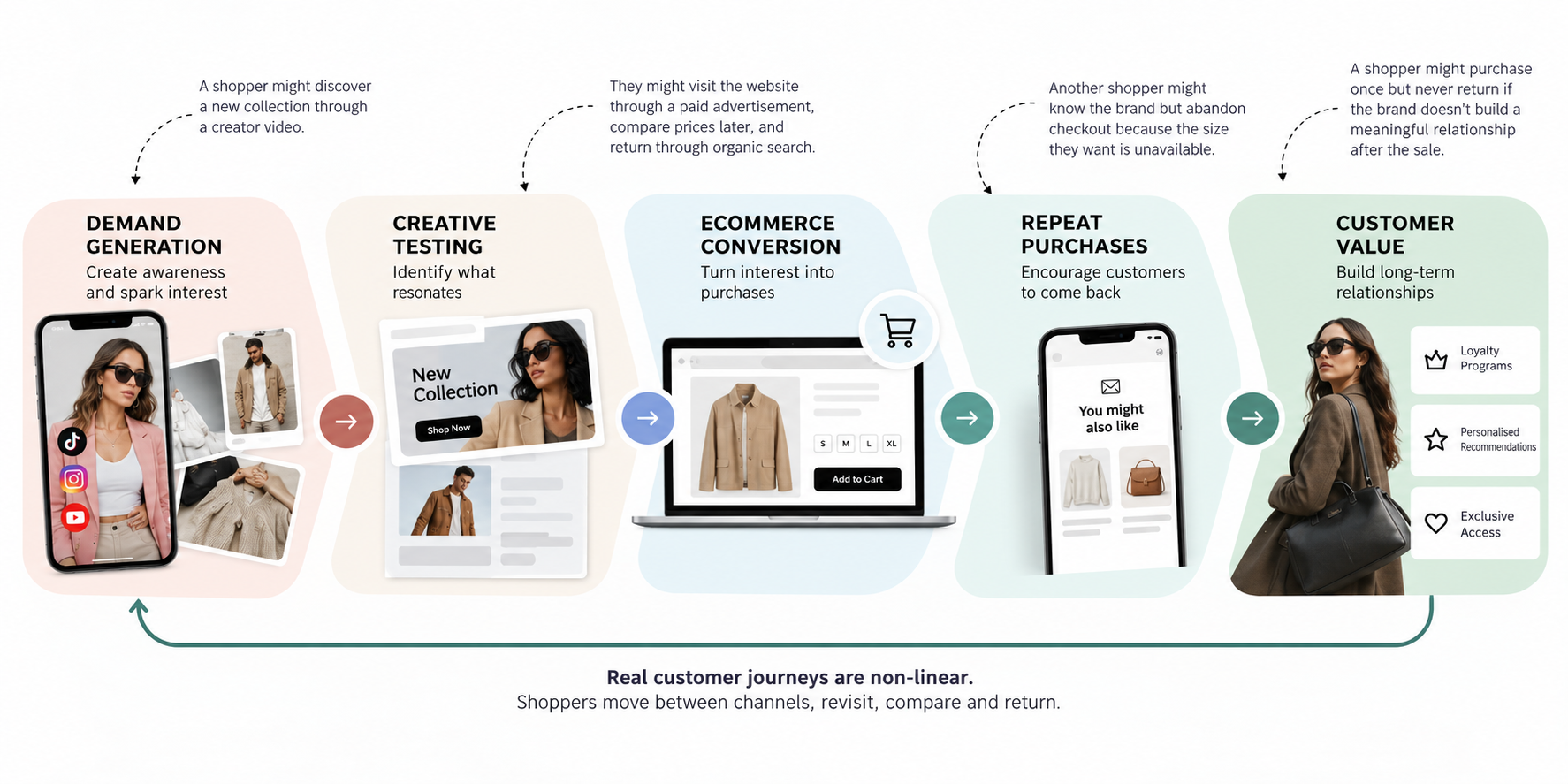
TOF, MOF, and BOF can help teams organise campaign objectives. However, real customer behaviour rarely follows a perfectly linear path.
A shopper might discover a new collection through a creator video, visit the website through a paid advertisement, compare prices on another day, return through organic search, and purchase after seeing a different product.
Another shopper might already know the brand but abandon checkout because the size they want is unavailable. A third might purchase once but never return because the brand does not build a meaningful relationship after the sale.
These situations require different responses. Increasing awareness will not solve a stock availability problem, and retargeting will not automatically fix an unconvincing product page.
A growth marketing agency for Apparel & Fashion brands should use funnel stages as a planning tool while evaluating the complete business system.
What Should Fashion Brands Focus on Beyond TOF, MOF and BOF?
1. Understand Demand Before Increasing Campaign Spend
Fashion demand changes with seasons, trends, occasions, product launches, and consumer preferences. A campaign that performed well for one collection may not work the same way for another.
Start by reviewing which categories attract demand, which products convert, and where the business has sufficient inventory to support additional sales.
Look at historical sales, product margins where available, search demand, campaign performance, and customer feedback. Separate products that need awareness from those that already have strong purchase intent.
For example, a new collection may require creative that introduces the design and styling options. An established product category with proven demand may benefit more from campaigns focused on purchase intent and conversion.
Avoid scaling a campaign simply because its initial ROAS looks promising. Check the product’s commercial contribution, stock availability, and capacity to sustain demand.
2. Treat Creative as a Growth System, Not a Production Task
Creative performance can influence how effectively fashion brands attract attention and communicate product value.
However, producing more advertisements does not guarantee better results. The creative needs to reflect customer motivations, product characteristics, and the context in which the audience encounters it.
Develop different concepts around meaningful angles, such as styling versatility, fit, fabric, product details, occasions, or collection identity. Use appropriate formats, including product imagery, styling videos, creator-style content, and collection demonstrations.
Each concept should have a clear purpose. One creative may introduce the product, another may answer a common objection, and another may demonstrate how the item can be styled.
Review performance at the creative level where reliable data is available. Consider qualified visits, add-to-cart activity, purchases, and acquisition efficiency rather than judging success only by views or engagement.
A growth marketing agency for Apparel & Fashion brands should connect creative research, production, testing, and learning. The goal is to understand which messages resonate and why, then use that knowledge to improve future campaigns.
Explore our creative portfolio.
3. Connect Meta Ads and Google Ads to Different Customer Needs
Meta Ads can help fashion brands introduce products, generate interest, test creative concepts, and reconnect with relevant audiences.
Google Ads can capture shoppers searching for specific products, categories, or brand-related terms. Shopping campaigns can showcase eligible products when the catalogue and account setup support them.
These channels can complement one another, but they should not automatically receive equal budgets.
Review where customers discover products, which searches indicate buying intent, and which campaigns generate commercially useful outcomes. Align advertisements with relevant collection and product pages.
For example, an ad promoting a particular dress collection should lead to a page where shoppers can browse that range. A search campaign targeting a specific product category should not send all visitors to the homepage.
Also account for product availability, pricing, shipping information, and tracking quality. Campaigns cannot compensate for an unavailable product or a confusing purchase process.
4. Create a Results-Oriented Ecommerce Conversion Growth Strategy
Fashion marketing does not stop at the click. The website must help shoppers evaluate products and complete purchases.
Review product imagery, size guides, fit information, fabric details, return policies, shipping costs, payment options, and mobile usability. These details can influence purchase confidence, particularly when customers cannot physically try on the product.
Use analytics to identify where visitors leave the journey. If product views are high but add-to-cart activity is weak, examine product information, pricing, imagery, and audience relevance. If carts are created but purchases remain low, review shipping costs, checkout friction, payment options, and trust concerns.
Avoid making multiple changes at once without a way to evaluate their effect. Prioritise the most important friction points and test improvements where practical.
A better conversion rate can improve the return on existing acquisition spend without requiring an immediate increase in advertising budget.
5. Build Organic Discovery Alongside Paid Acquisition
Fashion brands can become overly dependent on paid campaigns when product and collection pages do not attract meaningful organic traffic.
SEO for Apparel & Fashion Brands helps customers discover products through relevant category searches, specific product queries, and informational searches about fit, styling, materials, or care.
Start with collection and product pages that matter commercially. Ensure that they have clear titles, relevant metadata, useful product information, and logical internal links.
Then develop supporting content around genuine customer questions. Styling guides, fabric explanations, and product care articles can help customers evaluate products while creating additional routes to relevant collections.
Organic search requires consistent work and does not provide a guaranteed timeline for results. However, it can complement paid media by creating another source of discovery.
The important distinction is that SEO should support the brand’s commercial goals rather than become an isolated activity measured only by traffic.
6. Plan for Repeat Purchases, Not Just First Orders
Customer acquisition is only one part of ecommerce growth. Existing customers may be interested in new collections, complementary products, seasonal ranges, or future purchases.
Use available customer and purchase data to identify relevant communication opportunities. Depending on the brand and its setup, these may include email, SMS, new collection announcements, product recommendations, and post-purchase communication.
Avoid sending identical offers to every customer. Someone who bought a particular product category may respond differently from someone who regularly purchases across the catalogue.
Measure returning customer revenue, repeat purchase rate, and retention campaign performance where reliable tracking is available.
Discounts can support selected campaigns, but relying on discounts for every repeat purchase may weaken margins and train customers to wait for offers. Consider how product relevance, collection launches, customer experience, and brand affinity can also encourage people to return.
7. Connect Inventory and Marketing Decisions
Fashion brands face a challenge that is easy to overlook in campaign reporting: demand must align with stock.
A high-performing advertisement can become commercially unhelpful if the featured product sells out, popular sizes become unavailable, or the business cannot replenish inventory.
Marketing and merchandising teams should coordinate on product availability, new launches, bestsellers, seasonal priorities, and clearance requirements.
Campaigns can then reflect the products the business wants and is able to sell. Product feeds, landing pages, and advertisements should communicate current availability accurately.
This coordination also helps the brand distinguish between weak marketing performance and limitations caused by stock or assortment.
Before increasing spend, ask whether the product range can support the additional demand and whether the expected commercial return justifies the investment.
Which Metrics Should Fashion Growth Teams Monitor?
A useful measurement framework connects acquisition with profitability and customer value.
Customer acquisition cost: What does it cost to acquire a customer under the chosen measurement method?
ROAS: How much attributed revenue is generated relative to advertising spend?
Conversion rate: How effectively does the website turn visits into orders?
Average order value: How much revenue does a typical order generate?
Contribution margin: How much remains after relevant variable costs?
New versus returning customers: Is the business acquiring new buyers and encouraging repeat purchases?
Product-level performance: Which collections and products contribute to sales and profitability?
Inventory availability: Are campaigns promoting products and sizes that customers can actually purchase?
Organic search performance: Are relevant product, collection, and informational pages gaining visibility?
Avoid relying on one metric to make every decision. High ROAS may reflect a campaign that mostly captures existing demand, while a campaign with lower immediate returns may help introduce new customers. Evaluate each activity according to its purpose and contribution to the overall business.
How to Choose a Growth Marketing Agency for Apparel & Fashion Brands
A suitable agency should understand both marketing execution and the commercial realities of fashion ecommerce.
Ask how it approaches creative strategy, paid media, SEO, conversion optimisation, inventory considerations, and retention. Find out how it prioritises work, which team members will be involved, how reporting is structured, and how recommendations are implemented.
Review relevant case studies, but distinguish documented outcomes from general service descriptions. Ask what work was completed and which results can be verified.
Also consider whether your team needs a full external partner, specialist support for selected channels, or a hybrid model. The right arrangement depends on existing skills, budget, internal capacity, and business priorities.
A growth marketing agency for Apparel & Fashion brands should be able to explain not just which campaigns it will run, but how those campaigns fit into a wider plan for customer acquisition and business performance.
Why Growthify?
Growthify approaches fashion growth by connecting performance marketing, Meta Ads, Google Ads, creative strategy, SEO, ecommerce optimisation, and customer retention. We’d begin by understanding the product catalogue, target customers, commercial priorities, inventory considerations, and existing performance. From there, we’d identify the most important constraint, whether it is demand generation, creative performance, website conversion, organic discovery, or repeat purchasing. The strategy should evolve as customer behaviour and business needs change. Instead of treating TOF, MOF, and BOF as isolated campaign stages, the focus is on building a connected system that supports measurable business growth.