From Search to Story: How Can Content Marketing Help Jewellery Brands Stand Out?
Problem Statement
Jewellery brands often invest in attractive product photography and social media posts, yet customers may struggle to understand what makes the brand worth choosing. Content marketing for jewellery brands helps bridge this gap by communicating product value beyond visuals. Product images can show a design, but they may not explain the materials, craftsmanship, styling possibilities, care requirements, or differences between products. Meanwhile, search traffic can remain limited if collection and product pages do not address relevant queries. Publishing more content is not necessarily the answer. Brands need a clear content strategy that helps customers discover products, understand their value, remember the brand, and feel confident enough to consider a purchase.
Why Jewellery Brands Need More Than Product Photography
Jewellery is highly visual, but buying decisions often involve practical questions as well as aesthetics.
A customer may want to understand whether a piece suits everyday wear, how to care for it, what materials it uses, how it differs from alternatives, or whether it fits a particular occasion.
Content can answer these questions before the customer contacts the brand or leaves to research elsewhere.
Content gives products a reason to be remembered
Two brands may sell visually similar earrings or rings. Their product stories, styling guidance, design philosophy, and customer experience can help shoppers understand the differences.
The objective is not to invent a dramatic story for every product. It is to communicate meaningful details that help customers understand what they are considering.
Content supports multiple stages of discovery
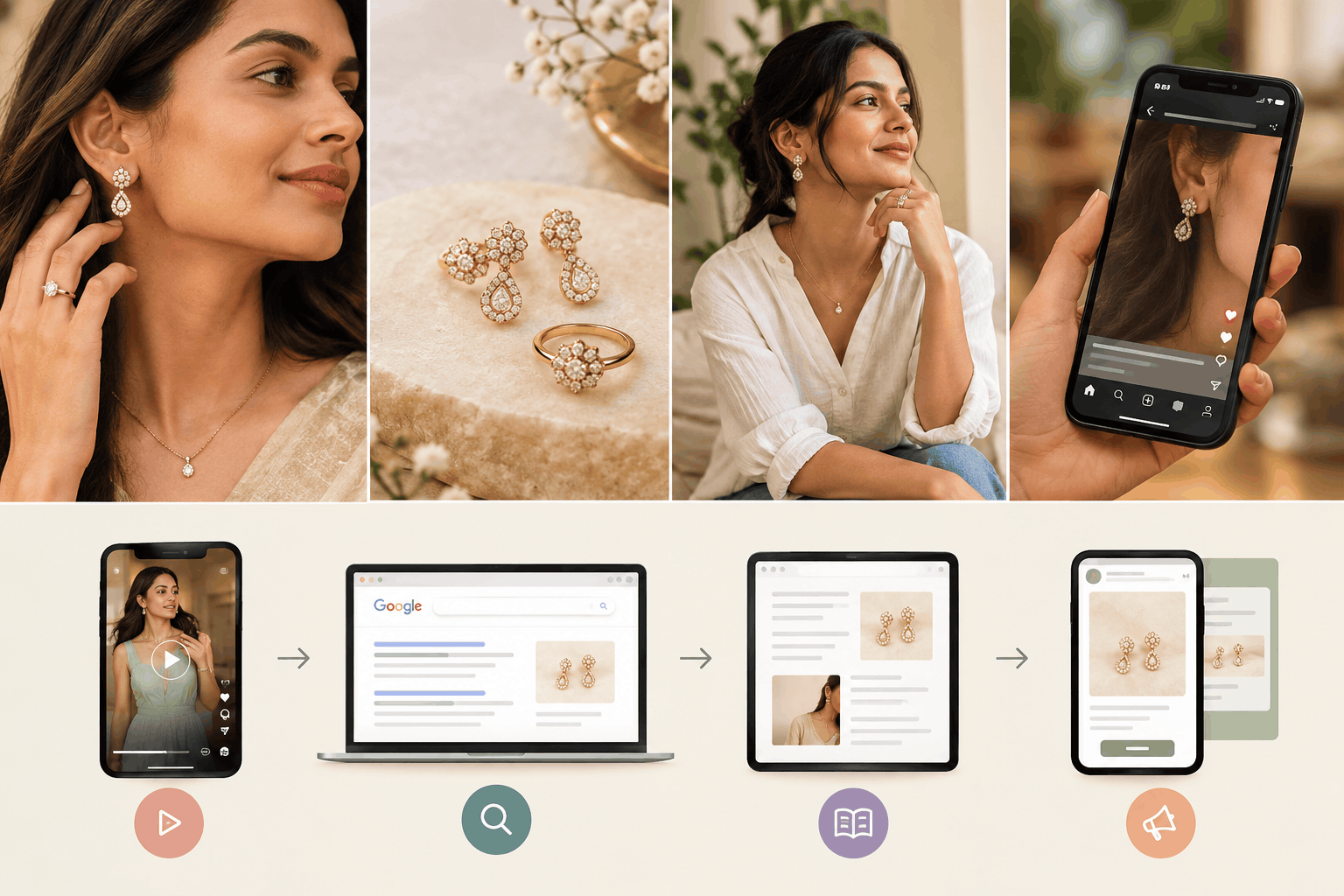
A customer may discover a jewellery brand through a styling video, visit its website through Google, read a product guide, and later return through a paid advertisement. Understanding how to grow jewellary brands online means connecting these touchpoints to create a consistent customer journey. Product pages help shoppers evaluate products, educational guides answer their questions, and social media content introduces jewellery through styling ideas and visual inspiration.
At Growthify, we’d plan these formats around the customer’s questions and the business’s commercial priorities, rather than publishing content simply to maintain a calendar.
What Should Content Marketing for Jewellery Brands Actually Include?
1. Start With the Questions Customers Ask Before Buying
Useful content begins with customer research.
Review search queries, customer support questions, product reviews, social comments, sales conversations, and common objections. Look for recurring questions about materials, product dimensions, styling, durability, care, pricing, and suitability for different occasions.
Then map these questions to the appropriate content format.
For example, a detailed article may explain how to care for sterling silver jewellery, while a product page should provide the specific care guidance relevant to the item being sold.
Avoid creating several articles that answer almost identical questions without a clear difference in purpose. Each content asset should have a defined audience, search intent, and next step.
2. Build Content Around Product and Category Discovery
If customers cannot discover your products through relevant searches, strong storytelling alone may not be enough.
Start with commercial pages. Collection pages should clearly communicate what shoppers can find in the category, while product pages should provide accurate descriptions, specifications, and useful supporting details.
Map relevant search terms to these pages based on intent. Queries about specific product types may belong on collection pages, while broader research questions may suit educational content.
Supporting articles should link naturally to relevant products or collections. For example, a guide about choosing earrings for different occasions can link to suitable earring collections when those links genuinely help the reader.
Do not force every article to target a transactional keyword. Informational content can attract people earlier in the journey, while collection and product pages serve more immediate buying intent.
3. Tell Product Stories Without Making Unsupported Claims
Jewellery storytelling can cover design inspiration, craftsmanship, material choices, styling versatility, product details, and the people behind the brand where those details are documented.
The strongest stories help customers understand the product instead of relying on vague language.
Consider the difference between saying that a ring is elegant and explaining its design, finish, proportions, available sizes, and styling possibilities.
For materials, certifications, sourcing, durability, and manufacturing, use verified information. Claims about diamonds, precious metals, ethical sourcing, or product composition should be accurate and supported by appropriate documentation.
This matters because jewellery is a category where customer confidence can influence purchase decisions significantly. Misleading descriptions may create short-term interest but undermine trust.
4. Create Visual Content That Works Across Channels
Jewellery products benefit from visual presentation, but each format should have a clear purpose.
Useful content formats include:
- Close-up product imagery that shows design details
- Styling videos demonstrating how pieces can be worn
- Product comparisons that explain meaningful differences
- Short videos answering common customer questions
- Collection stories introducing a coordinated range
- Customer-generated or creator-style content where appropriate
- Product care demonstrations using accurate guidance
- Occasion-based styling ideas connected to relevant products
A single concept can be adapted across a product page, social media, advertising, and email, provided each version suits the channel.
However, repurposing should not mean publishing the same asset everywhere without adjustment. A short social video may need a different opening, caption, or call to action when used in a paid campaign.
Check our creative portfolio.
5. Make Educational Content Useful for Search and AI Answers
Search visibility can extend beyond traditional blue links. Customers may encounter summaries in Google AI Overviews or AI Mode, and may use tools such as ChatGPT, Gemini, or Perplexity to research products and buying questions.
There is no guaranteed content trick that secures visibility in these experiences. The practical approach is to make content genuinely useful, clear, accurate, and accessible.
For jewellery brands, that means:
- Answering the main question near the beginning
- Using descriptive headings that match the reader’s needs
- Explaining technical terms in plain language
- Providing original insights and verified product details
- Keeping product and category information consistent
- Linking to relevant products, guides, and service pages
- Maintaining a clear website structure
For example, an article about jewellery care should give the reader useful guidance directly, explain relevant limitations, and link to suitable products only when appropriate.
AI visibility should complement the broader content strategy, not replace the fundamentals of search relevance and user value.
6. Connect Content With Paid Advertising and Retention
Content can also help advertising campaigns communicate product value.
A product demonstration, styling concept, or educational video may provide a useful creative angle for Meta Ads. Search campaigns can direct users to product pages or category pages that match their intent.
Use performance data to identify which messages attract relevant visitors and which content helps move them closer to a purchase.
Content can support retention as well. After a purchase, customers may benefit from product care instructions, styling suggestions, or information about complementary pieces. Such communication should be relevant to the purchase and the customer’s preferences.
Avoid treating every content interaction as an immediate sales opportunity. Some content builds familiarity and answers questions before the customer is ready to buy.
7. Measure Whether Content Is Helping the Business
Content performance should be evaluated according to its purpose.
For jewellery SEO content, monitor impressions, clicks, rankings, organic landing-page traffic, and relevant internal-link engagement. For product pages, review product views, add-to-cart activity, conversion rate, and revenue where reliable tracking is available.
For social and video content, consider meaningful engagement, qualified website visits, and performance when the asset is used in campaigns.
Also look at assisted conversions and the contribution of content to the broader customer journey where measurement allows it.
Not every article will generate direct sales immediately. However, every important content asset should have a reason to exist, an audience it serves, and a way to assess whether it remains useful.
Where Jewellery Content Strategies Commonly Go Wrong
Publishing frequently without a clear strategy can produce a large library of content that attracts little relevant traffic.
Other common issues include generic product descriptions, repetitive articles, unsupported material claims, weak internal links, and social content that looks attractive but does not communicate product value.
Brands can also overlook existing opportunities by publishing new articles while important collection and product pages remain incomplete.
At Growthify, we’d start by auditing what already exists, identifying gaps in search and customer education, and prioritising content based on its relevance to product discovery and business goals.
Why Growthify?
Growthify approaches content marketing by connecting customer research, SEO, product storytelling, creative development, and ecommerce goals. We’d identify what customers need to understand before buying, which search opportunities matter commercially, and where existing product pages or content are falling short. From there, we’d plan useful content that supports discovery, explains product value, and connects readers with relevant collections. Performance data helps refine future topics and formats. The objective is to build a content system that improves product discovery and brand recall while supporting the wider customer acquisition journey.