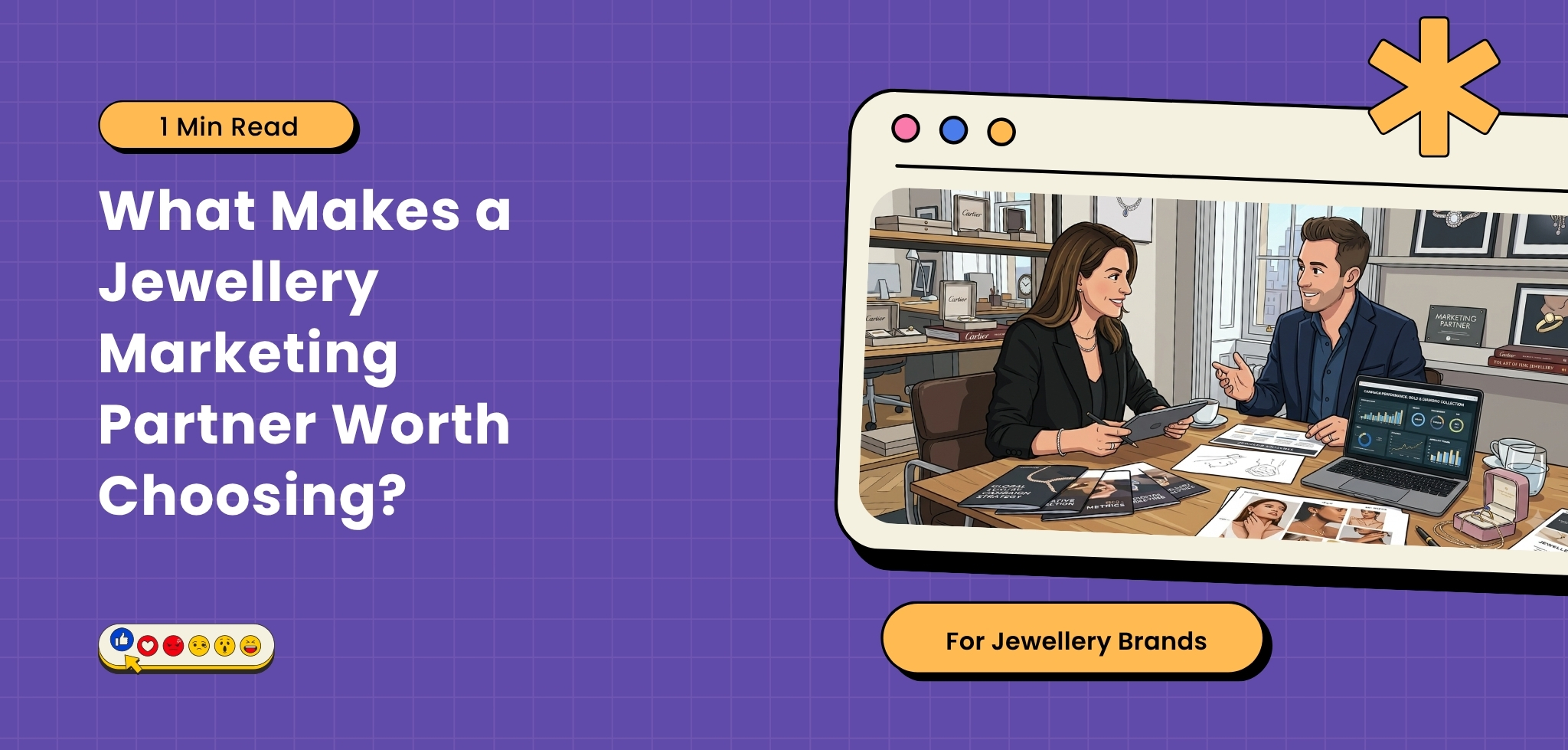
What Makes the Best Jewellery Marketing Agency Worth Choosing?
Problem Statement
Choosing a jewellery marketing agency can look straightforward until you start comparing proposals. One agency promises better ROAS, another focuses on social media engagement, and another offers SEO, content, and website improvements. Yet jewellery brands face specific challenges: customers need confidence in product quality, materials, pricing, craftsmanship, and authenticity before purchasing. High-value purchases can require several interactions, while lower-priced products may need a different acquisition strategy. The real question is not which agency offers the most services. It is which partner understands your business well enough to turn marketing activity into commercially meaningful results.
Why Jewellery Brands Need More Than a Campaign Management Agency
Jewellery is a visual category, but attractive product photography alone rarely explains why someone should buy from a particular brand.
Customers may compare designs, materials, certifications where applicable, craftsmanship, price, shipping, returns, and brand credibility. The buying journey also changes depending on whether the brand sells everyday silver jewellery, fashion jewellery, fine jewellery, wedding jewellery, or lab-grown diamond pieces.
An agency that treats every jewellery brand like a generic ecommerce store may miss these differences.
The purchase journey is rarely identical for every product
A customer buying an affordable pair of earrings may make a relatively quick decision. Someone considering a diamond ring or a high-value jewellery piece may need more reassurance, product education, and time.
Your marketing partner should understand these differences and align campaign messaging, landing pages, and follow-up communication accordingly.
Revenue and profitability are not the same
A campaign can generate sales while still putting pressure on margins through discounts, advertising costs, shipping, returns, and other expenses.
At Growthify, we’d want to understand what the brand is trying to achieve before deciding which marketing metrics matter most. More revenue, better customer acquisition efficiency, stronger organic visibility, and profitable growth may require different priorities.
What Should You Look For When Choosing a Jewellery Marketing Agency?
1. Look for Commercial Understanding, Not Just Jewellery Experience
Experience in jewellery can be useful, but it should not be the only selection criterion.
Ask whether the agency understands your price points, target customers, product categories, margins where available, inventory considerations, and competitive positioning.
A brand selling affordable everyday jewellery may need strong product discovery, efficient acquisition, and repeat purchase activity. A premium jewellery brand may need more emphasis on storytelling, craftsmanship, trust, and purchase consideration.
The agency should be able to explain how these business differences influence its recommendations.
Ask for a clear explanation of how it would approach your catalogue, customer journey, and growth goals. Be cautious if the proposal simply lists standard activities without connecting them to your products or commercial priorities.
Explore our jewellery brand case studies to see how we approach marketing strategies based on each brand’s products, audience, and growth goals.
2. Evaluate How It Connects Creative With Performance
Jewellery marketing depends heavily on visual presentation. Product photography, styling, videos, creator content, and advertising concepts all influence how shoppers perceive a brand.
However, creative should do more than look attractive.
A strong agency should explain what each concept is designed to communicate and how it will be evaluated. For example, one concept might highlight craftsmanship, another could show styling versatility, and another might address questions about materials or product care.
Ask how the agency researches customer objections, develops creative concepts, tests variations, and uses performance data to inform future production.
Look beyond the number of videos or static ads promised. The more important question is whether the creative strategy produces useful learning and supports business objectives.
3. Check Whether Paid Advertising Is Connected to the Website
Meta Ads and Google Ads can attract shoppers, but campaign performance depends partly on what happens after the click.
If an advertisement promotes a particular jewellery collection, the landing page should help shoppers explore that collection easily. Product pages should clearly communicate price, materials, dimensions, care guidance, shipping, and return information where relevant.
An agency should review landing-page relevance, mobile usability, product availability, checkout friction, and conversion tracking.
For example, if product views are strong but add-to-cart activity is weak, the issue may involve pricing, product information, or the offer. If shoppers add products to their carts but do not complete purchases, delivery costs or checkout concerns may be contributing.
The agency should investigate these possibilities instead of automatically recommending a higher advertising budget.
4. Assess Its SEO and Content Capabilities
Paid advertising is only one route to customer acquisition. Organic search can help jewellery brands reach shoppers researching designs, product categories, materials, and buying considerations.
A capable partner should understand category-page optimisation, product-page SEO, internal linking, technical SEO, and content planning.
Content also supports purchase confidence. Guides explaining jewellery materials, styling, care, product differences, and buying considerations can help shoppers make informed decisions.
If your goal is to understand how to grow jewellery brands online, evaluate whether the agency can connect SEO and content with relevant products and commercial landing pages. Traffic should have a clear purpose within the customer journey.
5. Ask How Reporting and Attribution Work
A report full of impressions, clicks, followers, and attributed revenue does not necessarily explain whether the business is growing efficiently.
Ask the agency which metrics it tracks, how it defines conversions, how often it reviews performance, and how it accounts for differences between advertising platforms and ecommerce analytics.
Relevant measures may include customer acquisition cost, conversion rate, average order value, revenue, contribution margin, new customer share, and repeat purchase rate.
ROAS is useful, but it should be interpreted alongside product margins and other variable costs.
The agency should also be transparent about attribution limitations. A customer may discover a brand through social media, return through search, and purchase later. No single platform report necessarily captures the complete journey.
6. Understand the Team, Process, and Scope
Before signing a contract, clarify who will manage the account, who develops creative, who reviews performance, and who is responsible for implementation.
Understand the difference between strategic recommendations and actual execution. For example, an agency may identify website conversion issues but require your development team to implement fixes.
Ask about deliverables, communication frequency, reporting, revision processes, approval timelines, and how priorities are agreed.
A clear working process reduces confusion and helps the agency focus on the work most likely to improve performance.
Red Flags to Watch for Before Signing
Be cautious when an agency guarantees a fixed ROAS or revenue outcome without understanding your business. Historical performance from another brand does not guarantee the same result for yours.
Other warning signs include:
- Recommendations based on generic packages rather than your catalogue and objectives
- Reporting that focuses on platform metrics without business context
- Creative production without a clear testing or learning process
- SEO plans based only on publishing a fixed number of articles
- No explanation of conversion tracking or attribution
- Unclear ownership of advertising accounts, data, or creative assets
- Pressure to scale budgets before performance and tracking have been evaluated
A good agency should explain its assumptions, identify constraints, and be honest about what it can and cannot control.
Also read our latest guide: What red flags should I watch for when hiring a UGC agency?
Agency vs In-House Marketing: Which Is Right for Your Jewellery Brand?
An in-house team offers direct brand knowledge, close coordination with merchandising, and immediate access to internal business information. It can be particularly useful when marketing requires daily coordination with inventory, product launches, and customer support.
An agency can bring specialised capabilities across paid media, SEO, creative production, and ecommerce optimisation without requiring the brand to hire every specialist internally.
A hybrid model may work best for some businesses. An internal marketing manager can own priorities and brand consistency while an external partner supports execution and specialist strategy.
The decision should depend on the skills already available, the workload, the required speed of execution, and the cost of building and managing the team.
Why Growthify?
Growthify approaches jewellery marketing by connecting customer acquisition, creative strategy, ecommerce performance, SEO, and business measurement. We’d begin by understanding the brand’s product range, positioning, customer journey, and commercial priorities before deciding which channels deserve investment. Paid campaigns, product-page improvements, content, and retention should work together rather than operate as separate activities. The aim is to help jewellery brands make better marketing decisions, identify what influences purchase behaviour, and evaluate performance using business outcomes rather than surface-level engagement alone.