
How to Choose a Home Decor Marketing Agency That Understands Your Brand
Problem Statement
Home and decor brands often face a frustrating gap between attention and sales. Customers may love a sofa, lamp, cushion or decorative piece online but still need to decide whether it suits their home, fits their space and justifies the price. Social media content can earn likes without generating orders, while paid campaigns may bring visitors who leave without buying. Choosing a marketing partner becomes difficult when every agency promises growth but few explain how they will market products that customers need to visualise in their own homes. The right partner must understand both the emotional and commercial sides of the purchase.
Why Home & Decor Marketing Needs a Different Approach
Home decor is rarely an impulse purchase across every product category. A customer buying a small decorative accessory may decide quickly, while someone buying furniture may compare dimensions, materials, colours, delivery options and prices for several weeks.
Customers also need to imagine the product in their own environment. A product image may look beautiful, but buyers still want to know whether it will fit their room, match their existing furniture or work for their daily needs.
That means marketing needs to do more than attract attention. It should help customers:
- Discover products that match their style and needs.
- Understand dimensions, materials, finishes and use cases.
- Visualise products in real spaces.
- Compare options and evaluate value.
- Find answers to delivery, care and return questions.
- Feel confident enough to complete a purchase.
When evaluating how to choose a home decor marketing agency, look beyond whether the agency can run ads or publish social posts. Ask whether it understands the full journey from inspiration to purchase.
What Should You Look for in a Marketing Partner?
1. Does the agency understand your products and customers?
A suitable partner should ask about your product range, price points, margins, best-selling categories, delivery coverage and customer concerns before recommending channels.
For example, a customer buying a decorative vase may care most about its appearance, size and styling potential. A customer buying a dining table may need information about dimensions, material, seating capacity, delivery and maintenance.
The marketing strategy should reflect these differences.
Ask the agency:
- Which products or categories would you prioritise first?
- What customer questions should our marketing answer?
- How would you market high-consideration products differently?
- What would you review before recommending an advertising budget?
- How would you connect marketing activity to sales?
The answers should be specific to your business. A standard ecommerce plan with your brand name added is not enough.
2. Can it create content that helps customers imagine products at home?
Home decor is visual, but attractive images alone may not answer the questions that influence a purchase.
Look for an agency that can plan room-based styling, product demonstrations, close-up details, customer stories, short videos and creative variations for different audiences.
Creative services for home decor brands should help customers understand how products look, work and fit into their lives. A video showing the scale of a chair in a living room may answer a practical question. A styling reel may help someone imagine how a product could complement their space. A customer video may offer a more relatable view of the product.
Ask how the agency:
- Researches customer motivations and objections.
- Develops creative concepts and hooks.
- Briefs creators or production teams.
- Tests different formats and messages.
- Uses campaign results to improve future content.
- Handles content approvals and usage rights.
Avoid choosing a partner based only on how polished its portfolio looks. The important question is whether its creative process can support your business goals.
3. Does it understand SEO for home decor brands?
Search can help customers discover products while they are actively researching categories, styles and solutions for their homes.
Home decor brand SEO may include product and collection page optimisation, room-based content, buying guides, internal linking, technical improvements and useful category descriptions.
A customer may search for furniture for a small apartment, a particular interior style, storage solutions or decor ideas for a new home. Your website should have relevant pages that answer those needs.
Ask the agency how it would:
- Research product and category search demand.
- Improve collection pages without making them repetitive.
- Create useful content around customer questions.
- Connect informational guides to relevant products.
- Improve internal links and site structure.
- Measure organic traffic that contributes to product discovery and sales.
Be cautious if SEO is presented only as a promise to improve rankings. The agency should explain how search visibility connects to the pages that matter commercially.
4. Can it manage performance marketing with realistic expectations?
Paid advertising can help home decor brands reach new customers, promote products and re-engage people who have already shown interest. But performance depends on more than campaign settings.
Performance marketing for home decor should connect audience targeting, creative testing, product availability, pricing, landing pages and measurement.
Ask how the agency plans to:
- Separate prospecting from remarketing.
- Test lifestyle-focused and product-focused creative.
- Prioritise products and categories for campaigns.
- Review landing-page performance.
- Track purchases and meaningful customer actions.
- Evaluate results alongside margins and average order value.
A good partner should not treat every click or add-to-cart as a business result. It should help you understand which campaigns contribute to sales and where customers drop off.
5. Will it improve the website experience, not just send traffic?
Marketing can bring visitors to a website, but the website still needs to help them make a decision.
For home decor products, useful product-page information may include dimensions, materials, finishes, care instructions, delivery details, return policies and photographs from multiple angles.
The agency should be able to identify issues such as unclear product descriptions, missing measurements, confusing navigation, weak mobile experience or unnecessary checkout steps.
Ask whether conversion improvements are included in the scope or whether the agency can work with your website team.
Also consider what happens after a purchase. Customers may return for complementary products, seasonal updates or another room. CRM and retention activity can help the brand maintain a useful relationship with customers without sending irrelevant messages.
How Can You Evaluate an Agency Before Signing?
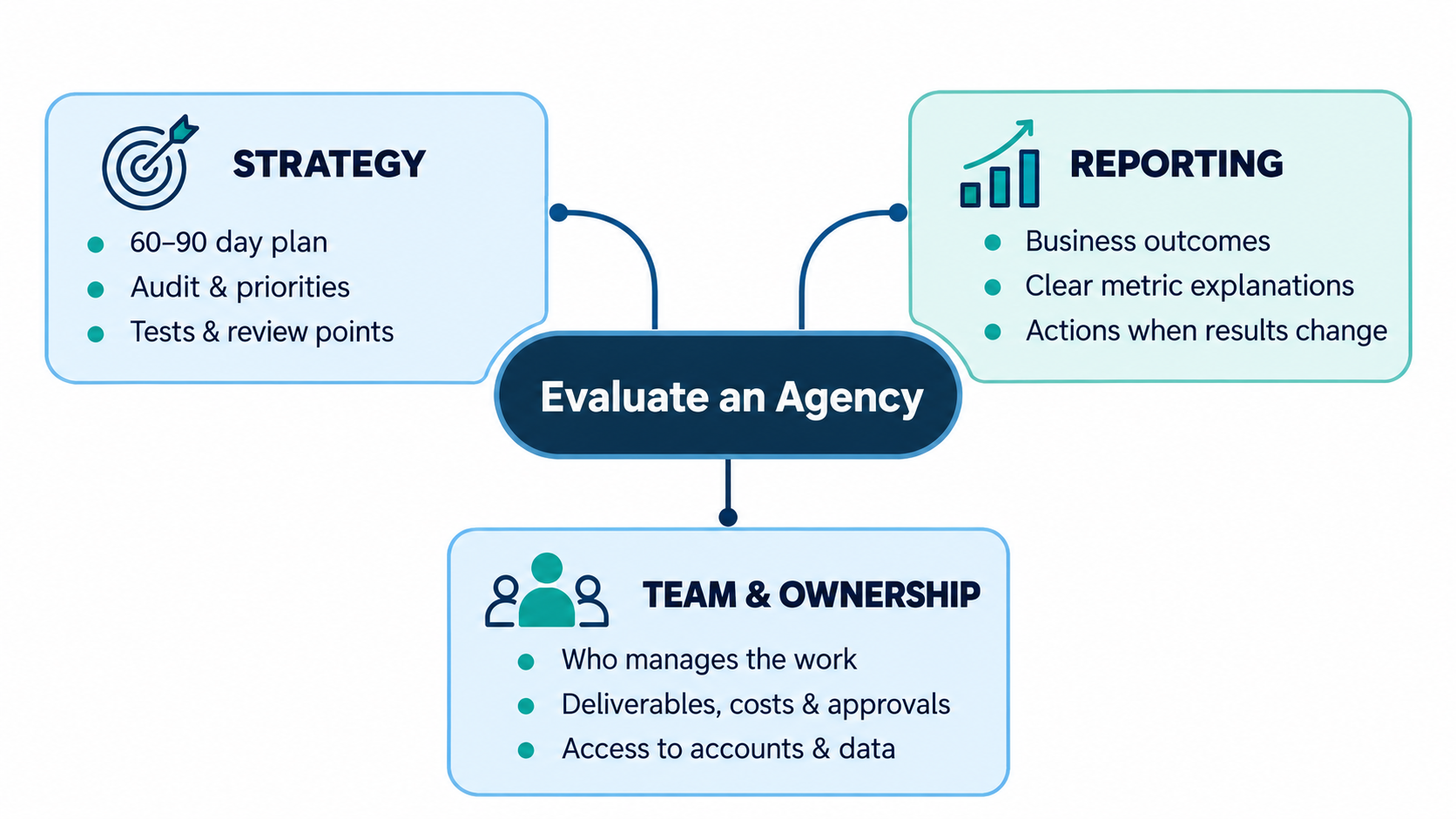
Review the strategy, not just the presentation
A polished pitch does not prove that the agency understands your business. Ask for a practical outline of the first 60 to 90 days.
The plan should explain:
- What the agency will audit first.
- Which products, categories or channels it will prioritise.
- What information it needs from your team.
- What will be tested and why.
- How performance will be reviewed.
- Which decisions will depend on early results.
A useful plan should be specific enough to show the agency’s thinking while acknowledging that priorities may change after reviewing actual data.
Ask how reporting will work
Reporting should help you make decisions. It should not simply list impressions, clicks and follower growth.
Depending on your business model, useful measures may include revenue, orders, conversion rate, cost per acquisition, return on ad spend, average order value, organic product-page traffic and qualified enquiries.
Ask the agency to explain what each metric means and what it would do if performance changed.
Understand who will actually manage the work
Find out who will manage your account, create content, handle campaigns, review data and communicate with your team.
Clarify meeting frequency, approval processes, turnaround times, deliverables, additional production costs, creator fees, ad spend and content ownership.
Make sure your business retains access to advertising accounts, analytics, website tools and campaign data. Clear responsibilities reduce delays and prevent misunderstandings later.
What Are the Warning Signs?
Be cautious if an agency:
- Promises fixed sales results before reviewing your business.
- Recommends every channel without explaining priorities.
- Talks only about reach, followers or traffic.
- Uses the same strategy for every ecommerce category.
- Cannot explain its creative testing process.
- Avoids discussing website conversion.
- Provides unclear reporting or limited account access.
- Uses case studies without explaining the actual scope of work.
The goal is not to find an agency that claims it can do everything. It is to find a partner that can identify what matters most for your brand and explain how it will work toward it.
How to Grow a Home Decor Brand With the Right Partner
The agency should help you identify the main growth constraint before recommending more activity.
If customers are not discovering your products, the priority may be SEO, category visibility or acquisition campaigns. If visitors arrive but do not buy, the issue may be product information, creative expectations, pricing or website experience. If customers buy once but do not return, retention and complementary product marketing may deserve attention.
A practical plan to grow home decor brand should connect these areas rather than focus on a single channel.
Start with a small number of clear priorities, measure what changes and expand the work when the evidence supports it.
Why Growthify
Growthify approaches home and decor marketing by connecting the work that attracts customers with the work that helps them make a purchase. Depending on the brand’s needs, this can include SEO, content marketing, Meta Ads, Google Ads, creative strategy and ecommerce improvements. We would start by understanding the product range, customer journey, business priorities and current performance before deciding where to focus. The aim is to build a marketing system that supports product discovery, gives customers useful reasons to consider the brand and helps the business make better growth decisions.