Problem Statement
Choosing a D2C marketing agency in India can be challenging when multiple agencies offer similar services, from paid advertising and social media marketing to SEO and conversion optimisation. However, the real difference lies in how an agency connects these activities to business outcomes. A brand may generate clicks without profitable sales, increase traffic without improving conversions, or acquire customers without building a sustainable growth model. For D2C founders and marketing teams, comparing agencies requires looking beyond service lists and evaluating their strategy, execution, reporting, and ability to support business growth.
1. What Should You Compare When Choosing a D2C Marketing Agency?
A D2C marketing agency should do more than manage advertising campaigns. It should understand the brand’s business model, customer journey, margins, product positioning, and growth targets before recommending a marketing strategy.
When comparing Growthify with other agencies, evaluate the following areas.
Performance marketing expertise
Paid campaigns on platforms such as Meta and Google can help D2C brands reach potential customers and generate sales. However, campaign performance depends on more than platform settings.
Assess whether an agency considers:
-
Audience research and segmentation
-
Campaign structure and budget allocation
-
Creative testing and ad messaging
-
Customer acquisition cost (CAC)
-
Return on ad spend (ROAS)
-
Contribution margin and profitability
-
Retargeting and customer retention opportunities
The goal is to understand whether the agency focuses only on campaign delivery or also considers how advertising contributes to business performance.
Creative strategy and testing
Ad creatives influence how customers understand a product, evaluate its benefits, and decide whether to purchase. An agency should have a clear process for testing different hooks, product demonstrations, offers, formats, and messages.
Ask how the agency identifies creative opportunities, measures results, and applies campaign learnings to future ads.
Conversion rate optimisation
Generating traffic is only one part of D2C growth. Product pages, landing pages, pricing, trust signals, checkout experience, and shipping information can all influence whether visitors purchase.
A capable agency should be able to identify potential conversion barriers and recommend improvements alongside its acquisition strategy.
Measurement and reporting
Agency reports should explain what happened, why it happened, and what the team plans to do next. Look for transparent reporting that connects advertising metrics with website conversions and business outcomes.
Useful indicators include CAC, ROAS, conversion rate, average order value, repeat purchase rate, and revenue quality. Not every metric will be equally important for every brand, so reporting should reflect the business model and objectives.
2. Growthify vs Other D2C Marketing Agencies in India
Not all D2C marketing agencies operate in the same way. Some focus primarily on paid media, while others provide a broader mix of marketing services. The best fit depends on whether a brand needs a specialist for one channel or a coordinated approach to growth.
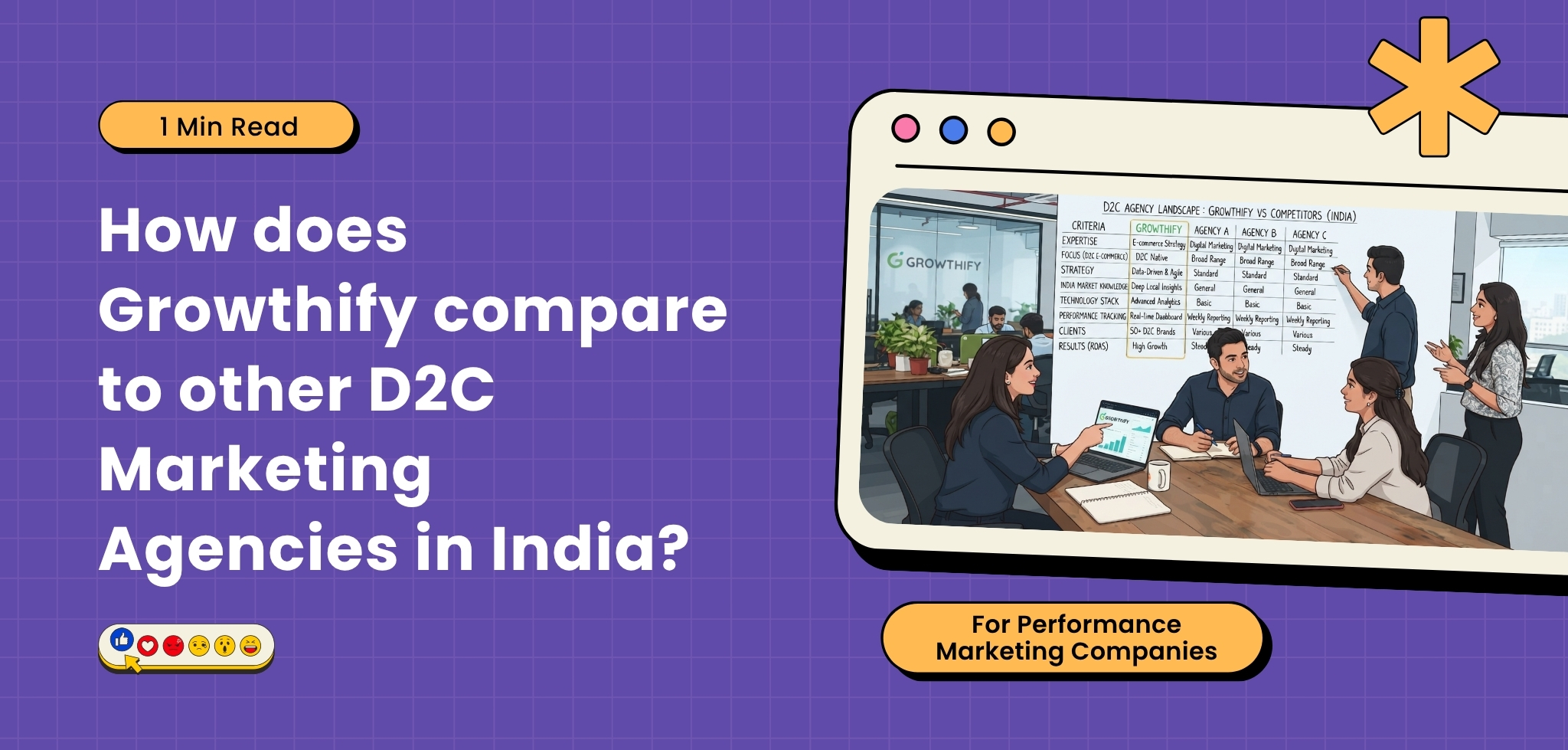
The following comparison framework can help businesses evaluate Growthify alongside other agencies.
| Evaluation factor | What to look for in Growthify and other agencies |
|---|---|
| Performance marketing | How campaigns are planned, managed, tested, and optimised |
| Creative strategy | How ad concepts, messaging, and formats are developed and evaluated |
| Conversion optimisation | Whether landing pages and website journeys are reviewed for conversion barriers |
| Data and analytics | How tracking, attribution, and reporting support decisions |
| Business understanding | Whether the agency considers margins, product demand, and customer behaviour |
| Communication | How frequently the team shares updates, insights, and next steps |
| Scalability | Whether the strategy can adapt as budgets, product ranges, and order volumes grow |
These factors offer a practical way to compare agencies without relying on unsupported claims about which company is best.
Does the agency connect marketing activities?
A common challenge for D2C brands is managing disconnected marketing activities. Paid ads may be handled by one team, creative production by another, and website optimisation by a separate resource. Without coordination, important insights can get lost between teams.
When evaluating Growthify, ask how its performance marketing services connect campaign insights, creative testing, audience targeting, and conversion improvements. Ask other shortlisted agencies the same questions to make the comparison fair.
Does the agency understand commercial goals?
A campaign that produces revenue is not necessarily profitable. Product costs, shipping, discounts, payment processing, returns, and repeat purchases can influence the actual business impact of marketing.
An agency should understand the commercial targets behind the campaign and help the brand evaluate performance against those targets. This is particularly important for D2C businesses operating with tight margins or varying product profitability.
3. How Growthify’s Performance Marketing Approach Fits D2C Brands?
Growthify’s performance marketing services are relevant to brands looking to make their digital advertising more structured, measurable, and connected to business growth.
When assessing Growthify for a D2C business, consider these areas of its potential contribution and verify the specific scope, deliverables, and working process during the evaluation.
Campaign strategy and audience targeting
Campaign planning should begin with the brand’s objectives, audience, product offering, and current performance data. These inputs help establish campaign priorities, budget allocation, and testing requirements.
For example, a brand introducing a new product may need to validate audience demand and messaging before scaling spend. An established brand may instead need to improve acquisition efficiency or expand into new customer segments.
The right strategy depends on the business’s current stage rather than a standard campaign structure applied to every account.
Creative testing and performance analysis
Creative testing helps brands understand which product benefits, messages, and formats resonate with different audiences.
An agency should have a repeatable process for:
-
Identifying creative opportunities from customer insights and campaign data.
-
Developing variations in hooks, messaging, and formats.
-
Testing creatives against clearly defined objectives.
-
Reviewing results across relevant performance metrics.
-
Applying the findings to future creative and campaign decisions.
This process makes creative development more informed by performance data instead of relying entirely on subjective preferences.
Budget optimisation and campaign scaling
Increasing an advertising budget should follow evidence of sustainable performance. A sudden increase in spend can change audience reach, acquisition costs, and campaign efficiency.
A structured scaling approach considers conversion volume, marginal acquisition costs, creative fatigue, inventory availability, and contribution margins. These factors help determine when to increase spending, maintain current budgets, or revisit the campaign strategy.
Growthify and any competing agency should be able to explain how budget decisions are made, what indicators trigger changes, and how performance is communicated to the brand.
Website and conversion performance
Even a well-targeted campaign can underperform if visitors encounter unclear product information, weak trust signals, slow pages, or a complicated checkout process.
Brands should assess whether their chosen agency can identify such issues and coordinate with the appropriate website or conversion optimisation team. If website optimisation falls outside the agency’s scope, clarify who will handle it and how recommendations will be implemented.
4. What Can the IAFA Furniture Case Study Tell You?
A relevant case study can help D2C brands understand how an agency approaches a real business challenge. Growthify’s IAFA Furniture case study can be considered during the evaluation of its work with a furniture brand.
However, a case study should be assessed using documented project information rather than assumptions about results.
What to examine in the case study
The original business challenge:
Understand the brand’s starting position, marketing objectives, target audience, and specific challenges that the project aimed to address.
The strategy and execution:
Review the marketing activities used, why they were selected, and how the team approached campaign optimisation and customer acquisition.
The documented results:
Look for verified figures covering relevant outcomes, such as revenue, ROAS, CAC, conversion rate, or qualified enquiries, depending on the project’s objectives.
The lessons for other brands:
Consider which aspects of the strategy could apply to your business and which would need to change based on your products, margins, audience, and buying cycle.
Why case study context matters
Furniture purchases can involve different considerations from everyday consumer products. Buyers may need more time to decide, compare specifications, evaluate quality, or consider delivery arrangements.
This makes it important to understand the project’s actual objectives and customer journey before drawing conclusions about its relevance to another D2C brand.
Use the IAFA Furniture case study as a starting point for discussion, and request verified project details before treating it as evidence of specific performance outcomes. Do not assume results or metrics that are not documented.
5. How to Choose Between Growthify and Other D2C Marketing Agencies?
The right agency should fit your business requirements, internal capabilities, and growth stage. Use the following steps to make a more informed decision.
Step 1: Define your marketing objectives
Identify what you need the agency to improve. Your priorities might include increasing online sales, improving paid campaign efficiency, testing new creative approaches, launching products, or expanding into new markets.
Set measurable objectives before comparing proposals. This makes it easier to determine whether each agency’s strategy addresses your actual needs.
Step 2: Review relevant experience
Ask each agency to share relevant work and explain its role in the project. Industry experience can be useful, but the agency’s ability to understand your business challenge is equally important.
For a D2C brand, relevant experience might include working with similar price points, product categories, purchase cycles, or acquisition challenges.
Step 3: Compare the proposed strategy
A proposal should explain the agency’s approach, priorities, deliverables, reporting structure, and expected responsibilities.
Be cautious of proposals that focus only on advertising budgets, platform names, or broad growth promises without explaining how the strategy will be executed and evaluated.
Step 4: Understand the reporting process
Ask what information you will receive, how often results will be reviewed, and how the team will respond when campaigns underperform.
A useful reporting process should help you understand both campaign performance and the next actions required to improve it.
Step 5: Evaluate cost and commercial fit
Compare agency fees, advertising spend, creative production costs, additional services, contract terms, and internal resource requirements.
The lowest fee is not automatically the best option. Equally, a higher fee does not guarantee better performance. Evaluate the proposed scope and the value it offers relative to your business objectives.
Step 6: Clarify communication and accountability
Before signing a contract, establish who will manage your account, who approves creative work, how frequently meetings take place, and how urgent issues are handled.
Clear responsibilities reduce confusion and help both teams work toward the same objectives.
6. Questions to Ask Growthify and Other Agencies Before Hiring
Use these questions during agency discussions to compare their working methods and suitability.
-
How will you understand our products, target audience, and business goals before launching campaigns?
-
Which performance metrics will you prioritise, and why?
-
How do you approach creative testing and campaign optimisation?
-
How will you determine whether an advertising campaign is ready to scale?
-
What tracking and analytics setup do you recommend?
-
How do you identify potential conversion barriers on our website?
-
What will your reporting include, and how often will we review performance?
-
Can you explain the challenges, strategy, and verified results of a relevant case study?
-
Which activities are included in your fee, and which require additional investment?
-
What do you need from our internal team to execute the strategy effectively?
The quality of an agency’s answers can reveal how clearly it understands your requirements and how transparently it communicates its approach.
7. When Is Growthify a Suitable Option for a D2C Brand?
Growthify is worth evaluating if your brand is looking for performance marketing support and wants a clearer process for managing and measuring digital campaigns.
It may be relevant to businesses that want to:
-
Improve how their paid campaigns are planned and evaluated.
-
Use performance insights to guide creative testing.
-
Make advertising decisions based on measurable business objectives.
-
Identify opportunities to improve customer acquisition efficiency.
-
Establish a more structured approach to campaign optimisation and scaling.
Before choosing Growthify, confirm that its available services, experience, pricing, communication process, and delivery scope match your requirements. Compare these details with competing agencies using the same criteria.
No agency can guarantee a particular growth outcome. Results depend on factors such as product demand, pricing, competition, creative quality, budget, website experience, and operational capacity.
8. How Growthify’s Performance Marketing Services Can Support D2C Growth
Growing a D2C business requires a clear connection between marketing activities and commercial priorities. Performance marketing can help brands understand how campaigns contribute to customer acquisition and where improvements may be needed.
Growthify‘s Performance Marketing Services are the relevant service to explore when assessing support for campaign planning, execution, optimisation, and performance measurement.
Before engaging the team, discuss your current acquisition challenges, business targets, advertising budget, and expectations. Ask for a proposed approach that reflects your business stage rather than relying on generic promises.
The objective should be to establish a measurable marketing process, identify opportunities for improvement, and make informed decisions as the business grows.