Problem Statement
Growing a kidswear brand online takes more than running ads or posting attractive product photos. Parents want to understand sizing, fabric, comfort, quality, pricing, delivery, and return policies before they buy. As a best kidswear marketing agency, the right partner should understand how parents shop, how kidswear products are discovered, and how marketing activity connects to sales and long-term growth. At the same time, brands need to stand out in a competitive market without spending too much to acquire each customer. Choosing the wrong marketing partner can lead to disconnected campaigns, unqualified traffic, and limited repeat purchases.
1. Look for an Agency That Understands Kidswear Buyers
Kidswear marketing needs to address both product appeal and parent priorities. A colourful campaign might attract attention, but parents may still need practical information before purchasing.
A marketing partner should understand questions such as:
- Is the fabric comfortable for everyday wear?
- How should parents choose the correct size?
- Is the product suitable for a particular occasion or season?
- How easy is it to wash and maintain?
- What happens if the size does not fit?
- Does the price reflect the product’s quality and design?
The answers should influence product pages, ad creatives, landing pages, content, and customer communication.
The agency should also understand your specific segment. Baby clothing, toddler wear, everyday essentials, festive outfits, premium kidswear, and occasion wear may need different messaging and acquisition strategies.
2. Evaluate the Agency’s Service Capabilities
An agency does not necessarily need to offer every service in-house, but it should understand how the channels work together.
SEO for Organic Product Discovery
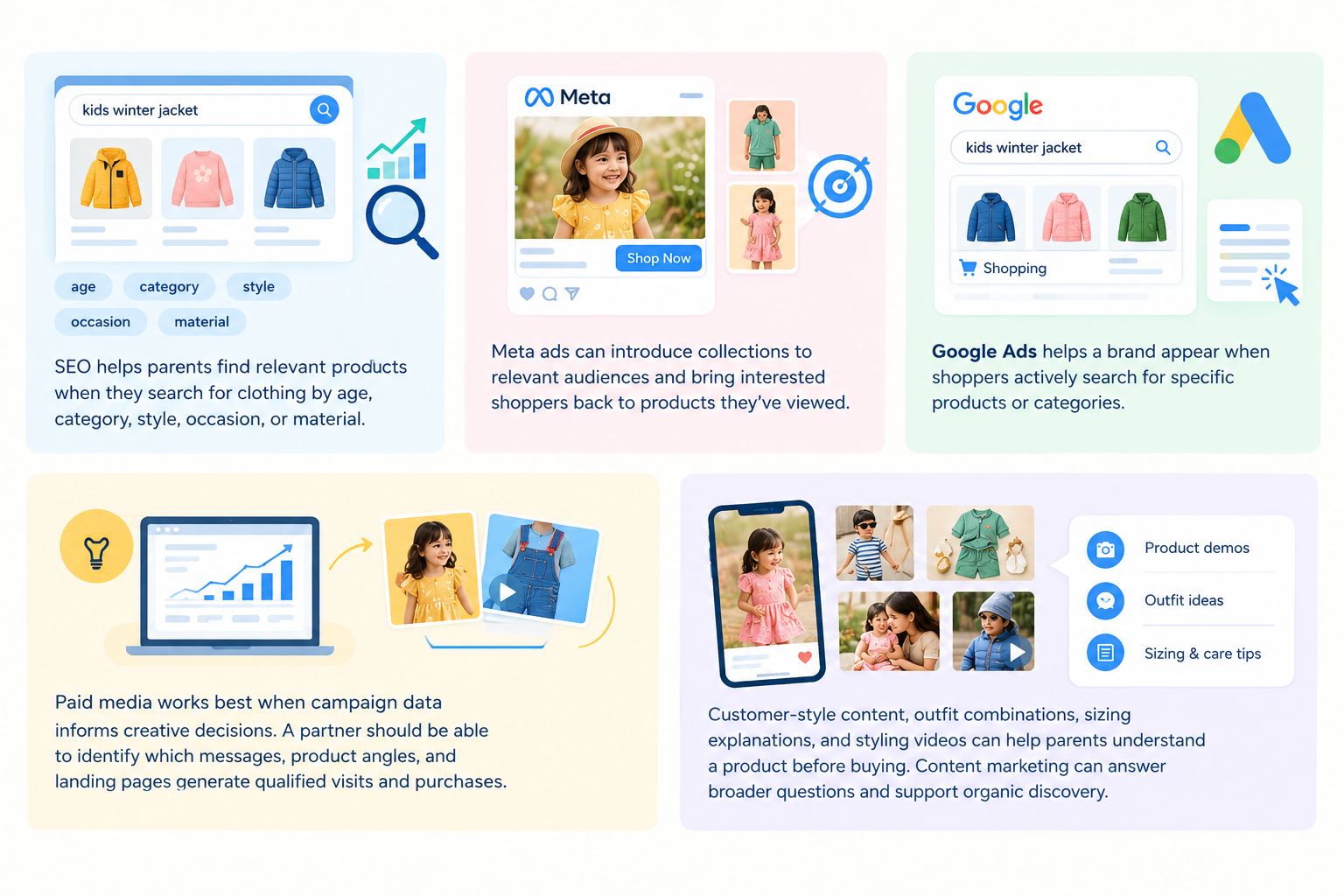
SEO helps parents find relevant products when they search for clothing by age, category, style, occasion, or material.
Ask whether the agency can improve category pages, product descriptions, internal links, site structure, product imagery, and technical SEO.
For a detailed look at organic growth, see SEO Services for Kidswear Brands as an example of how a category-specific service page can address industry needs.
Meta Ads for Product Discovery
Meta advertising can introduce collections to relevant audiences and bring interested shoppers back to products they previously viewed, where permitted by platform policies and applicable privacy rules.
A capable partner should explain how it tests creative concepts, audience approaches, product sets, landing pages, and campaign budgets.
Google Ads for High-Intent Searches
Google Ads can help a brand appear when shoppers actively search for particular products or categories. The agency should understand how to manage search campaigns, Shopping campaigns where eligible, search terms, product feeds, and conversion tracking.
The kidswear Google Ads strategy should account for age groups, product types, seasonal demand, pricing, and stock availability.
Performance Marketing and Creative Services
Paid media works best when campaign data informs creative decisions. A partner should be able to identify which messages, product angles, and landing pages generate qualified visits and purchases.
Review our Performance Marketing for Kidswear Brands and Creative Advertising for Kidswear Brands services.
UGC and Content Marketing
Customer-style product demonstrations, outfit combinations, sizing explanations, and styling videos can help parents understand a product before buying. Content marketing can answer broader questions and support organic discovery throughout the buying journey.
Explore UGC Content for Kidswear Brands and Content Marketing for Kidswear Brands services. Kidswear content should be adapted to parent concerns, not treated as generic fashion content.
3. Check How the Agency Approaches Trust and Conversion
Traffic is useful only when visitors can confidently evaluate the products.
Before recommending more ad spend, a strong agency should assess the shopping experience.
Look for a process that reviews:
- Clear size charts and fit guidance.
- Product photos that show colour, details, and garment construction accurately.
- Fabric composition and care instructions.
- Transparent shipping, exchange, and return information.
- Visible pricing, discounts, and product availability.
- Reviews and customer feedback presented honestly.
- A straightforward mobile shopping and checkout experience.
For ecommerce SEO, Google’s ecommerce SEO best practices explain how product information, site structure, and other search fundamentals help shoppers discover products.
The agency should also know how to identify friction through analytics, user behaviour, and conversion data rather than assuming that every sales problem can be solved by increasing advertising spend.
4. Ask for Relevant Experience and Verifiable Case Studies
Do not evaluate an agency only by the brands it lists on its website. Ask what work it actually completed, what challenge it addressed, and how the outcome was measured.
Questions worth asking include:
- Did the agency work on SEO, paid advertising, creative production, or the full marketing mix?
- What was the brand’s starting position?
- Which metrics were tracked?
- How were conversions attributed?
- What changed during the engagement?
- Can the agency explain what did not work and what it learned?
Growthify‘s Lil Drama, BabyBoo Shop, and Kay and Que Kids case studies can be linked here as relevant kidswear examples. Before publishing any performance claims, confirm each project’s scope, results, dates, and metrics from its documented case study. Do not assume the three projects delivered the same services or outcomes.
5. Understand Reporting, Budgeting, and Communication
A useful reporting process should connect marketing activity to business performance.
| Area | What to ask |
| Acquisition | How are new customers and acquisition costs measured? |
| Revenue | Are purchases and revenue tracked reliably? |
| Advertising | How are spend, ROAS, and campaign performance reviewed? |
| SEO | Are organic clicks, relevant landing pages, and conversions monitored? |
| Creative | How are creative tests evaluated and documented? |
| Communication | How often will the team review progress and priorities? |
Ask the agency to distinguish revenue attributed to a channel from incremental revenue caused by that channel. Attribution reports are useful, but they do not always establish causation.
Discuss the budget needed for media, agency fees, creative production, and tools separately. A realistic plan should account for inventory, margins, average order value, fulfilment costs, and return rates.
6. Compare an Agency With an In-House Team
An agency can bring specialist skills and an established testing process. An in-house team may offer closer daily access to products, operations, merchandising, and customer feedback.
The right choice depends on your resources and needs.
7. Build a Practical Evaluation Checklist
Before signing a contract, confirm that the agency can:
- Explain your customer and product positioning.
- Audit your website and existing marketing performance.
- Propose a strategy tied to business goals.
- Explain its channel mix and testing approach.
- Set up reliable conversion tracking.
- Report on business outcomes, not just activity.
- Clarify deliverables, ownership, fees, and communication.
- Support the brand as its product range and marketing needs change.
How Growthify Can Support Kidswear Brands
Growthify offers a range of growth services that can be connected to a kidswear brand’s needs, including SEO, Meta Ads, Google Ads, performance marketing, UGC, creative services, and content marketing.
The appropriate starting point depends on the brand’s current bottleneck. A store with limited organic visibility may need SEO and category-page improvements. A store receiving relevant traffic but few orders may need product-page and conversion improvements. A brand with proven product demand may be ready for more structured paid acquisition and creative testing.