What Is D2C SEO? A Practical Guide to Growing an Ecommerce Brand Organically
Problem Statement
For direct-to-consumer brands, attracting visitors to an ecommerce website is only part of the growth challenge. Customers need to discover the right products, compare options, understand product benefits, and feel confident enough to buy. Without a clear SEO strategy, even a well-designed online store can struggle to appear in relevant search results or convert organic traffic into revenue. D2C brands must optimise product pages, collections, technical performance, and educational content around how customers actually shop. Understanding D2C SEO is the first step toward building sustainable organic visibility and reducing dependence on paid acquisition.
1. What Is D2C SEO and Why Does It Matter?
D2C SEO helps brands that sell directly to consumers become more discoverable when potential customers search for relevant products, categories, solutions, or buying advice.
For example, a jewellery brand might want to appear for searches such as “minimalist gold earrings,” “diamond pendant necklace,” or “how to choose a necklace length.” A skincare brand may target searches related to product categories, ingredients, and skincare routines.
A well-planned D2C SEO strategy connects these searches with relevant website pages, helping shoppers find products and information that match their needs.
Why D2C brands invest in SEO
Reach customers with relevant search intent: SEO helps your brand appear when shoppers actively research products or explore purchase options.
Build a long-term acquisition channel: Organic visibility can continue generating visits without paying for every click, although maintaining performance requires ongoing work.
Improve product discovery: Optimised product and category pages make it easier for shoppers and search engines to understand your catalogue.
Support purchase decisions: Helpful guides, comparisons, and FAQs can answer questions that prevent customers from buying.
Reduce dependence on a single channel: SEO can complement paid advertising, social media, email marketing, and other acquisition channels.
SEO is not an instant replacement for paid campaigns. It is a long-term growth channel that can support more diversified customer acquisition when implemented consistently.
2. How D2C SEO Differs From B2B SEO
D2C SEO and B2B SEO use many of the same fundamentals, including keyword research, technical optimisation, relevant content, and performance measurement. Their strategies differ because their audiences, buying journeys, and conversion goals are different.
| SEO factor | D2C SEO | B2B SEO |
| Target audience | Individual consumers and online shoppers | Business buyers and decision-makers |
| Main objective | Generate product discovery and ecommerce sales | Generate qualified leads and sales opportunities |
| Keyword focus | Product, category, comparison, and purchase-intent searches | Business problems, solutions, services, and vendor searches |
| Important pages | Product pages, category pages, collections, buying guides | Service pages, solution pages, industry pages, case studies |
| Content formats | Product comparisons, buying guides, reviews, usage guides | Technical resources, industry guides, solution comparisons |
| Conversion actions | Add to cart, checkout, purchase, newsletter sign-up | Enquiry, demo request, consultation, quote request |
| Typical buying journey | Often shorter, depending on product and price | Often longer and involves multiple stakeholders |
| Key business metrics | Organic revenue, conversion rate, average order value | Qualified leads, sales opportunities, pipeline contribution |
For D2C brands, SEO must connect search visibility with product discovery and purchases. For B2B companies, it must support research, vendor evaluation, and lead generation.
Neither strategy is inherently better. The right approach depends on how your customers discover and buy what you offer.
3. Keyword Research for D2C Brands
Keyword research helps you understand what shoppers search for and which pages your website should provide.
The objective is not to target every keyword with high search volume. It is to identify relevant searches and map them to pages that satisfy the user’s intent.
Target different types of shopping searches
Product keywords
These searches describe a specific product or product attribute.
Examples:
- Gold-plated hoop earrings
- Cotton oversized T-shirts
- Hydrating face moisturiser
These terms may map to product pages or relevant collections, depending on the search intent.
Category keywords
These searches describe a broader group of products.
Examples:
- Women’s ethnic wear
- Minimalist jewellery
- Natural skincare products
Category and collection pages are often suitable targets because they allow shoppers to explore multiple relevant products.
Comparison and commercial keywords
These searches indicate that shoppers are evaluating their options.
Examples:
- Gold-plated vs gold-filled jewellery
- Best moisturiser for dry skin
- Running shoes comparison
Comparison pages and buying guides can help customers make informed choices while linking to relevant products.
Informational keywords
These searches indicate that people want to learn before purchasing.
Examples:
- How to measure ring size
- How to care for silver jewellery
- How to build a basic skincare routine
Educational content can attract relevant visitors earlier in the buying journey and direct them to appropriate product pages.
Map keywords to the right pages
Assign each important keyword cluster to the page that best answers the search.
Avoid creating multiple pages targeting essentially the same intent. Overlapping pages can confuse users and make it harder for search engines to determine which page is most relevant.
Review search results before finalising a page type. A keyword that appears transactional in isolation may have a different dominant intent in its actual search results.
4. Optimise Product and Category Pages
Product and category pages are central to D2C SEO because they connect search demand with your catalogue.
Product page SEO
Each important product page should make it clear what the item is, who it is for, and what makes it relevant to shoppers.
Focus on:
- Descriptive product titles
- Unique, useful product descriptions
- Accurate product specifications and attributes
- High-quality images with appropriate alt text
- Clear pricing, availability, and shipping information
- Relevant customer reviews where available
- Internal links to related products and categories
- Appropriate product structured data
Avoid copying identical manufacturer descriptions across large portions of your catalogue. Original, accurate information can help shoppers compare products and understand their differences.
Category and collection page SEO
Category pages help users explore a product range and can target broader commercial searches.
Optimise them with descriptive headings, useful introductory copy where appropriate, logical product organisation, and links to relevant subcategories.
Review how filters, sorting options, and product variants create URLs. Poorly managed faceted navigation can generate large numbers of low-value URLs and waste crawling resources.
Also consider how discontinued products, out-of-stock items, and duplicate product variants are handled. The right treatment depends on whether the page has ongoing value, relevant alternatives, or external links.
5. Technical SEO for Ecommerce Websites
Technical SEO helps search engines discover, crawl, and index the pages that matter.
D2C websites can face additional complexity because product catalogues change frequently and filters or variants may create many URLs.
Prioritise the technical foundations
Crawlability and indexation: Ensure search engines can access important product, category, and content pages. Prevent low-value URLs from overwhelming the crawl and indexation process.
Site architecture: Organise products into clear categories and use internal links to connect related pages.
Mobile usability: Make navigation, product selection, and checkout straightforward on mobile devices.
Page performance: Review loading speed, responsiveness, and visual stability, particularly on important landing pages.
Duplicate content: Manage near-identical product variants, URL parameters, and duplicate collection paths appropriately.
Structured data: Use relevant structured data, such as product information, where the page meets the applicable requirements. Structured data can help search engines understand page content, but it does not guarantee enhanced search results.
XML sitemaps: Include important, indexable URLs and keep sitemaps aligned with the website’s current structure.
Technical SEO should be prioritised according to its actual impact. Fixing a critical indexation problem may be more valuable than making minor improvements across hundreds of already healthy pages.
6. Content Marketing for D2C SEO
Content marketing supports D2C SEO by answering customer questions, explaining products, and helping shoppers make purchasing decisions.
A useful content strategy should complement the product catalogue rather than compete with it.
Create content around the customer journey
Awareness content: Help customers understand a category, need, or product-related topic.
Examples include introductory guides and educational articles.
Consideration content: Help customers compare alternatives.
Examples include buying guides, product comparisons, and material or ingredient explainers.
Decision-stage content: Help customers evaluate a specific product.
Examples include detailed product information, authentic reviews, demonstrations, and FAQs.
Post-purchase content: Help customers use and care for their products.
Examples include maintenance guides, usage instructions, and product care resources.
Use internal links to connect content and products
For example, a jewellery brand publishing a guide to choosing earrings for different occasions can link to relevant earring collections where the links are useful to readers.
This helps visitors move from research to product discovery while making important pages easier to navigate.
Prioritise content quality, factual accuracy, and genuine usefulness. Publishing large volumes of generic articles without a clear audience need is unlikely to create a strong competitive advantage.
7. How to Measure D2C SEO Performance
Rankings and organic traffic can help diagnose performance, but they do not tell the whole story.
A D2C SEO reporting framework should connect search visibility with customer behaviour and revenue.
| Objective | Metrics to track |
| Improve search visibility | Organic impressions, clicks, keyword visibility |
| Attract relevant shoppers | Organic landing page sessions, engaged visits |
| Improve product discovery | Product and category page traffic |
| Increase conversions | Ecommerce conversion rate, completed purchases |
| Generate revenue | Organic revenue, average order value |
| Improve acquisition efficiency | Organic acquisition cost estimates and channel contribution |
| Strengthen retention | Repeat purchase rate and customer lifetime value where measurable |
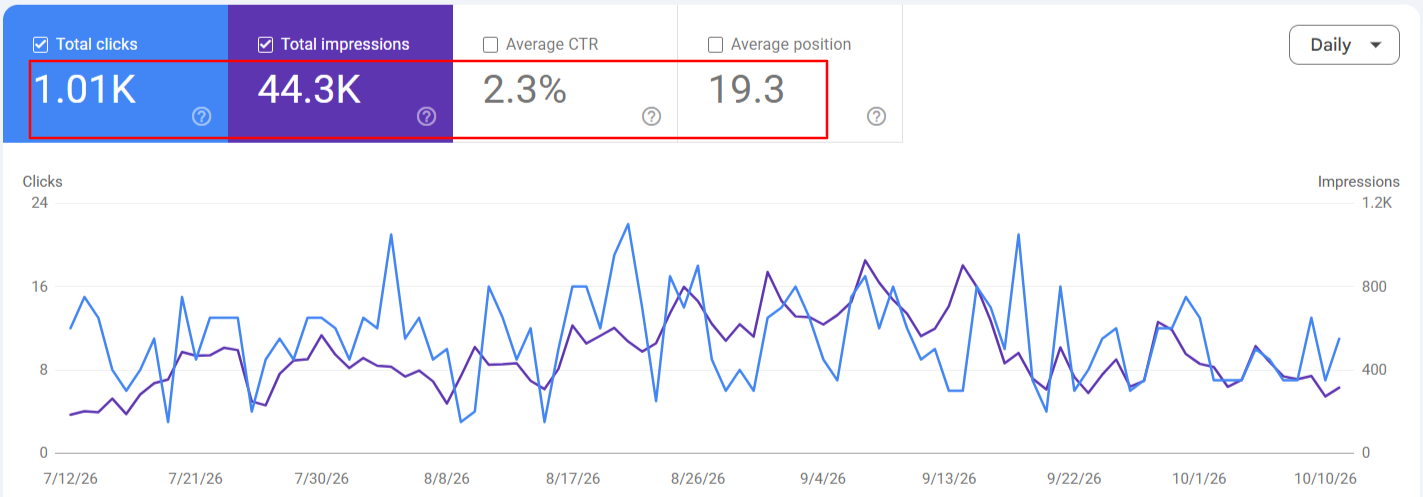
Use tools such as Google Search Console and your website analytics platform to understand which pages and search queries attract visitors.
If traffic increases but sales remain flat, investigate product relevance, pricing, page quality, user experience, and checkout friction. If sales improve without significant traffic growth, assess whether conversion improvements or changes in order value contributed.
Use a consistent measurement period and consider seasonality, promotions, inventory changes, and attribution limitations when interpreting results.
Here are some basic metrics you can track using Google Search Console:
8. Common D2C SEO Mistakes to Avoid
Targeting broad keywords without considering intent: High search volume is not enough if the audience is unlikely to buy your products.
Using duplicate product descriptions: Repeated descriptions make it harder for shoppers to understand product differences and can weaken page usefulness.
Ignoring category pages: Product pages matter, but well-structured category pages can be important entry points for broader commercial searches.
Publishing content without internal links: Educational content should connect naturally to relevant products, categories, and supporting resources.
Ignoring mobile shopping experience: Search visibility has limited commercial value if shoppers struggle to browse products or complete checkout.
Overlooking technical issues: Indexation problems, duplicate URLs, and poor internal linking can limit organic performance.
Measuring only rankings: Track whether SEO contributes to qualified visits, purchases, and business outcomes.
9. How Growthify Can Help With SEO Strategy
Although this guide focuses on D2C SEO, Growthify’s SEO services for B2B brands are designed around the needs of business audiences, where the priority is reaching decision-makers and generating qualified opportunities.
For B2B businesses, that can involve technical SEO, commercially focused keyword research, service page optimisation, content planning, and conversion tracking.
The wider lesson for any SEO programme is to align search strategy with the company’s business model. D2C brands need a plan that connects product discovery with purchases, while B2B brands need a plan that connects search visibility with qualified leads and sales opportunities.
Growthify‘s SEO approach should be tailored to the audience, website structure, competitive landscape, and commercial objectives of the business rather than applying the same page and content strategy to every company.