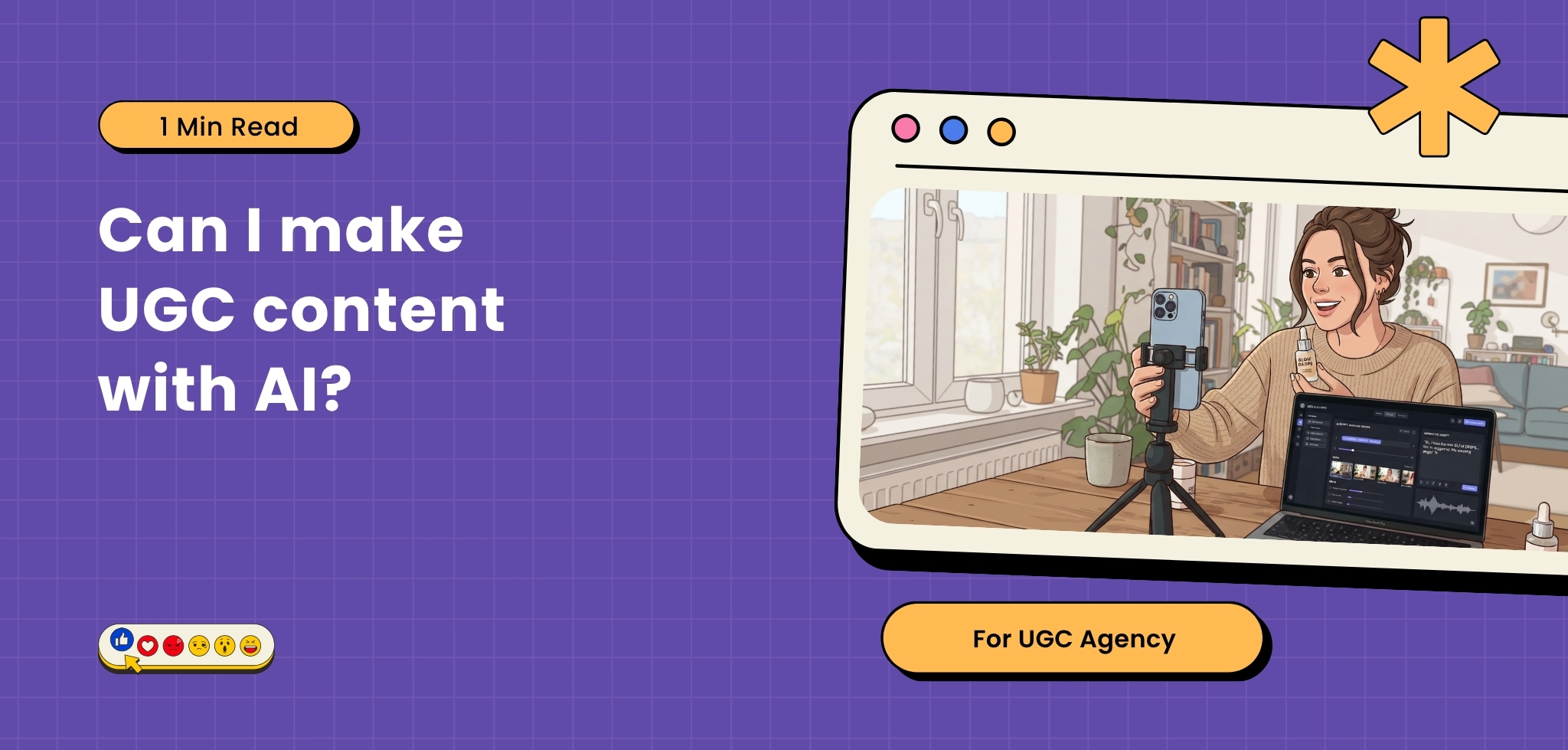
Can You Make UGC Content With AI Without Losing Customer Trust?
Problem Statement
D2C brands need a steady supply of fresh creatives to keep their advertising campaigns effective. But hiring creators, coordinating shoots, editing videos and managing revisions can quickly consume time and budget. AI tools now make it possible to generate product demonstrations, creator-style videos, scripts and virtual presenters without organising a traditional shoot. The challenge is that content that looks like a genuine customer recommendation may not represent a real customer experience. Brands need to understand where AI can help, how to maintain credibility and when human creators remain the better choice.
What Is AI UGC Content?
AI UGC content usually refers to AI-generated or AI-assisted content designed to resemble the natural, relatable style of user-generated content. It may include selfie-style videos, product demonstrations, conversational scripts and creator-style advertisements.
The important distinction is that UGC describes the content’s source or style, while AI describes how it is produced. A genuine customer video edited with AI remains customer-generated content. A fictional AI avatar presenting a product is AI-generated UGC-style content, not a real customer’s testimonial.
How Can D2C Brands Create UGC-Style Content With AI?
1. Start with a customer problem, not an AI prompt
The strongest UGC-style advertisements focus on a specific customer need, question or objection.
For example, a skincare brand might address how a product fits into a busy morning routine. A fashion brand might focus on fit, styling or how an outfit looks in everyday situations.
What to do: Identify three common customer questions and develop a separate creative concept for each.
What to avoid: Generic scripts filled with exaggerated praise and vague claims such as “This product changed my life.”
2. Generate scripts and creator-style video concepts
AI can help develop hooks, short-form video scripts, scene descriptions, captions and calls to action. Video-generation tools and virtual presenters can then turn selected concepts into visual assets.
A simple script structure could be:
- Hook: Introduce a relatable problem.
- Product introduction: Explain how the product fits the situation.
- Demonstration: Show relevant features or usage.
- Call to action: Encourage the viewer to explore the product.
Keep the language natural and the claims verifiable. Do not create a fictional first-person testimonial that implies the presenter personally used the product.
3. Make product visuals accurate
AI can generate backgrounds, lifestyle scenes and alternative creative concepts. However, it may alter packaging, colours, proportions, product features or how a product functions.
Use approved product photographs and reference assets wherever possible. Review every generated scene against the actual product before publishing.
For brands selling physical products, visual accuracy directly affects customer expectations, purchase confidence and the likelihood of returns or complaints.
Check Ai generated statics here.
4. Produce variations for advertising tests
One practical advantage of AI is the ability to explore different hooks, formats and visual directions without recreating every concept from scratch.
For example, you could test a problem-focused opening against a product-demonstration opening and a benefit-led opening.
Measure click-through rate, conversion rate, customer acquisition cost and return on ad spend where relevant. Do not assume that lower production costs automatically mean better campaign profitability.
When Should You Use AI Instead of Human UGC Creators?
| Situation | Recommended approach |
| Testing new hooks and concepts | AI-assisted creative variations |
| Producing fictional lifestyle scenarios | AI-generated visuals, with product accuracy checks |
| Showing a genuine customer experience | Real customer or creator content |
| Building trust through testimonials | Verified customer experiences with permission |
| Creating premium brand campaigns | Professional production, editorial creative or a suitable hybrid |
| Scaling multiple ad versions | Combine AI assistance with human creative direction |
AI works best when speed, experimentation and production flexibility are priorities. Human creators remain particularly valuable when personal experience, authentic demonstrations, cultural context or a distinctive personality matters.
The two approaches can complement each other. A real creator’s footage can be edited or adapted with AI, provided the creator’s consent, original meaning and any applicable usage rights are respected.
What Should Brands Check Before Publishing AI UGC Ads?
Before publishing, verify that:
- Product appearance and demonstrations accurately reflect reality. (Product dimensions and proportions usually changes due to weak prompting)
- Synthetic presenters are not misleadingly represented as real customers. (Human interaction and characters my look unreal if the story line, direction notes and angles are not properly planned. Creating synthetic or too polished reuslts)
- Health, beauty, performance and other product claims are supported by evidence.
- Music, images, likenesses and other assets are appropriately licensed.
These checks matter because a creative that attracts clicks but misleads customers can undermine brand trust and create compliance risks.
Why Growthify?
At Growthify, we’d approach UGC content creation as a combination of creative strategy, production and performance testing. Our UGC content creation services can help brands develop creator-style concepts, scripts and advertising assets aligned with their products and audiences. Where AI is appropriate, it can support faster concept development and creative variations. We’d still prioritise product accuracy, authentic customer insights and clear messaging, then evaluate performance against meaningful campaign objectives. Divine Mornings is a relevant client reference from Growthify’s portfolio, but its specific UGC or AI creative work and outcomes should be verified before being presented as a case study.