How to Grow a Kidswear Brand Online: The Growth Playbook
Problem Statement
Growing a kidswear brand online is not simply about increasing website traffic or running more advertisements. Parents need reasons to trust a brand, understand its products, and feel confident choosing the right clothing for their children. Brands looking for how to grow a kidswear brand online need a strategy that connects customer trust, product presentation, and marketing performance. Meanwhile, brands must manage inventory, seasonal demand, customer acquisition costs, and competition across ecommerce channels. Without a connected growth strategy, SEO, paid ads, content, and creative campaigns can operate independently and produce inconsistent results. Sustainable growth starts with a clear customer proposition, a trustworthy shopping experience, and a marketing system that connects discovery to purchase and repeat buying.
1. Build a Clear Positioning Strategy Before Scaling Marketing
Before investing more in marketing, clarify why parents should choose your brand.
For brands evaluating how to choose marketing agency for kidswear brands, understanding your own positioning is an important first step. A suitable agency should understand your target audience, product range, business priorities, and the challenges of marketing children’s clothing.
Define the following:
- Target customer: Who buys your products, and what matters to them?
- Product positioning: What makes your range distinctive?
- Price point: Are you positioned as affordable, mid-market, or premium?
- Purchase occasions: Is the clothing intended for everyday use, gifting, celebrations, or particular seasons?
- Customer concerns: What questions about fit, fabric, quality, or returns need to be answered?
- Business priorities: Are you trying to acquire first-time customers, increase repeat purchases, improve margins, or expand a collection?
Your website, advertising, product content, and customer communication should reinforce the same positioning.
2. Make Your Ecommerce Website Ready for Growth
Sending more visitors to a website will not solve unclear product information or a difficult checkout process.
Start by reviewing the shopping experience on mobile and desktop.
Improve Product Pages
Every important product page should help parents evaluate the garment without unnecessary effort.
Include:
- Accurate product names and descriptions.
- Clear images showing the product’s details.
- Size charts and fit guidance.
- Fabric composition and care instructions.
- Available colours, sizes, and stock status.
- Clear shipping, exchange, and return information.
- Genuine customer reviews where available.
Use product descriptions to explain the garment’s real features rather than filling them with repeated keywords.
Organise Category Pages
Build clear categories around how customers browse your range, such as age group, clothing type, season, or occasion where those distinctions genuinely match your catalogue.
Ensure that important categories are accessible through navigation and internal links. Avoid creating large numbers of near-identical pages that provide little additional value.
Google’s ecommerce SEO best practices provide guidance on product discovery, site structure, and ecommerce search optimisation.
Reduce Purchase Friction
Review the complete journey from product discovery to checkout.
Check whether shoppers can understand delivery costs, use available payment methods, find the return policy, and complete a purchase without unnecessary steps. Use analytics and customer feedback to prioritise improvements rather than making changes based on assumptions.
3. Use SEO to Build Long-Term Product Discovery
Investing in SEO for kidswear brands can help attract relevant organic traffic from parents looking for children’s clothing.
Target Relevant Search Intent
Build keyword groups around the actual products and questions your customers search for.
Potential categories include:
- Children’s clothing by age group.
- Everyday kidswear and seasonal collections.
- Occasion and festive clothing.
- Specific garment types.
- Sizing, styling, and garment-care questions.
Validate the search demand and competitiveness of each topic before prioritising it.
Optimise Important Pages First
Start with your highest-value category and product pages. Improve titles, headings, descriptions, images, internal links, page experience, and technical accessibility.
Add helpful articles to answer questions that product pages alone cannot cover. For example, a seasonal outfit guide could link to the corresponding collection, while a size guide could help shoppers navigate to the appropriate products.
Strengthen Product Data
Accurate structured data can help Google interpret product details. Google’s Product structured data documentation explains how eligible product pages can provide information such as price, availability, and reviews.
Structured data does not guarantee enhanced search appearances, so combine it with accurate product information and sound technical SEO.
4. Use Google Ads to Reach High-Intent Shoppers
Use Google Ads for kidswear brands to reach people actively searching for relevant clothing and products.
Depending on eligibility, catalogue quality, and business objectives, the strategy may include:
- Search campaigns for relevant product and category terms.
- Shopping campaigns or other product-based advertising formats.
- Brand search campaigns where appropriate.
- Product-feed improvements.
- Search-term reviews and negative keywords.
- Conversion tracking and landing-page optimisation.
Prioritise products that are available, commercially viable, and supported by accurate product information. A campaign should not send shoppers to unavailable products or pages that fail to answer their questions.
Measure campaign results against contribution margin and acquisition costs, not ROAS alone.
5. Use Meta Ads to Introduce Products and Test Demand
Meta Ads can help showcase new collections, product details, outfit combinations, and seasonal ranges.
The creative strategy should answer questions such as:
- Which product benefits attract attention?
- Which styles are relevant to the target customer?
- Which creative formats communicate product details clearly?
- Which messages generate qualified visits and purchases?
- Which products justify additional advertising investment?
Test a limited number of clear creative concepts and use the results to guide further iterations. Avoid changing audiences, budgets, creative, and landing pages simultaneously if doing so makes it difficult to understand performance.
Advertising must also comply with the policies relevant to the placement and audience. For example, Google’s policy for ads and made for kids content restricts personalised advertising and certain purchase prompts in content designated as made for kids. Review the applicable platform rules before launching campaigns.
6. Connect Performance Marketing With Creative Testing
Performance marketing is not only about campaign settings. The product offer, creative, landing page, audience, and measurement system all influence results.
A structured process should include:
- Identify the business goal and the customer problem.
- Develop creative concepts based on real product features.
- Test different hooks, formats, and product demonstrations.
- Evaluate qualified traffic and purchase outcomes.
- Review whether the landing page supports the message.
- Use the findings to guide the next round of tests.
Monitor spend, purchases, conversion rate, acquisition cost, average order value, and return on ad spend. Also consider product margins, fulfilment costs, discounts, and returns when evaluating profitability.
7. Use UGC and Content Marketing to Build Product Confidence
Parents often need more than a polished product image to understand a garment. UGC for kidswear brands can help showcase product details, fit, styling, and how clothing looks and works in everyday situations.
UGC and Product Demonstrations
Possible formats include:
- Close-up product demonstrations.
- Outfit combinations and styling ideas.
- Clear explanations of sizing and fit.
- Product unboxing and packaging.
- Genuine customer feedback and experiences.
Use appropriate consent for anyone featured, particularly children. Do not fabricate testimonials, imply unsupported product benefits, or publish identifying details without suitable permission.
Check our Creative Portfolio.
Content That Answers Parent Questions
Create helpful guides on clothing selection, sizing, styling, seasonal wardrobes, and care instructions. Connect these guides to relevant categories and products.
The companion guide Creating a Kidswear Brand Parents Discover, Explore and Trust can support this section once published. Its target keyphrase is content marketing for kidswear brands.
8. Use Case Studies to Inform Your Growth Strategy
The supplied case-study references are Lil Drama, BabyBoo Shop, and Kay and Que Kids.
Use them to help readers explore relevant Growthify experience, but make sure the linked case studies support the claims made in this section. Confirm which services were delivered, what the business challenge was, and whether any performance figures are documented.
A useful case-study presentation explains:
- The brand’s starting challenge.
- The scope of work.
- The strategy implemented.
- The metrics used to evaluate progress.
- The verified outcome and relevant learnings.
Do not invent ROAS, revenue growth, order volumes, or acquisition-cost improvements. If project details are not confirmed, use the case study as a related resource without claiming a particular result.
9. Measure Growth Beyond Traffic and ROAS
A growth dashboard should connect marketing performance to the business model.
| Metric | What it helps you understand |
| Organic clicks and relevant landing pages | Whether SEO is bringing relevant visitors |
| Conversion rate | Whether visitors are completing purchases |
| Customer acquisition cost | How much it costs to acquire customers |
| Average order value | How much customers spend per order |
| ROAS | Revenue attributed to advertising relative to ad spend |
| Contribution margin | Whether orders contribute enough after relevant costs |
| Repeat purchase rate | Whether customers return to buy again |
| Return and exchange rate | Whether fit, product expectations, or other issues need attention |
ROAS does not account for every cost, and attribution does not prove that a campaign caused all the revenue assigned to it. Review channel data alongside margins, new-customer performance, and overall business results.
10. Follow a Practical 90-Day Growth Roadmap
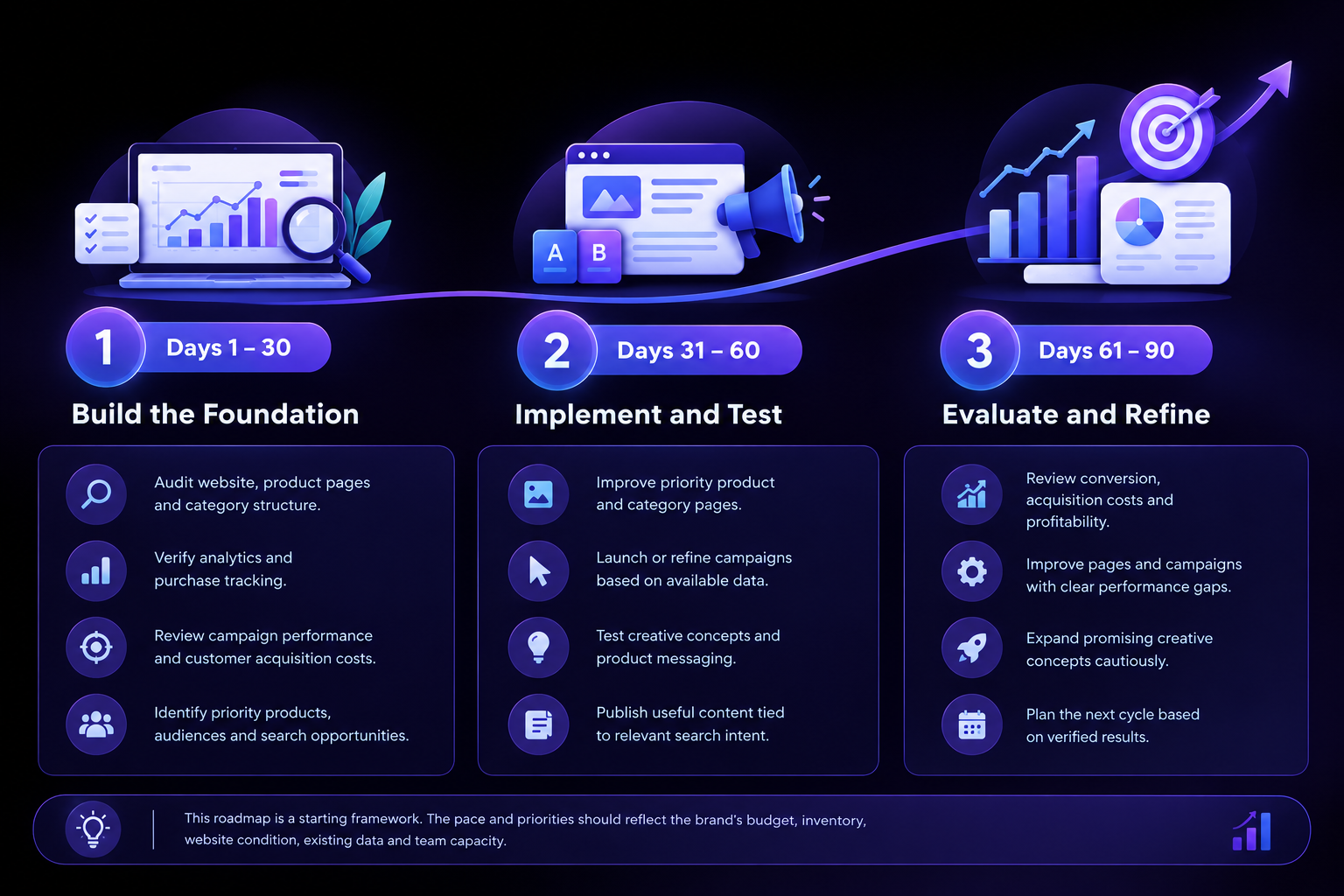
Days 1 to 30: Build the foundation
- Audit the website, product pages, and category structure.
- Verify analytics and purchase tracking.
- Review existing campaign performance and customer acquisition costs.
- Identify priority products, audiences, and search opportunities.
Days 31 to 60: Implement and test - Improve priority product and category pages.
- Launch or refine campaigns based on available data.
- Test creative concepts and product messaging.
- Publish useful content tied to relevant search intent.
Days 61 to 90: Evaluate and refine - Review conversion, acquisition costs, and profitability.
- Improve pages and campaigns with clear performance gaps.
- Expand promising creative concepts cautiously.
- Plan the next cycle based on verified results.
This roadmap is a starting framework. The pace and priorities should reflect the brand’s budget, inventory, website condition, existing data, and team capacity.
How Growthify Can Help Kidswear Brands Grow Online
Growthify‘s relevant service capabilities include SEO, Meta Ads, Google Ads, performance marketing, UGC services, creative services, and content marketing. These capabilities can be combined according to the brand’s specific growth challenges.
For example, a brand with limited organic visibility may prioritise SEO and content. A brand with validated products and reliable tracking may focus more on paid acquisition and creative testing. A brand attracting visitors but generating few purchases may need better product information, stronger landing pages, and conversion optimisation.