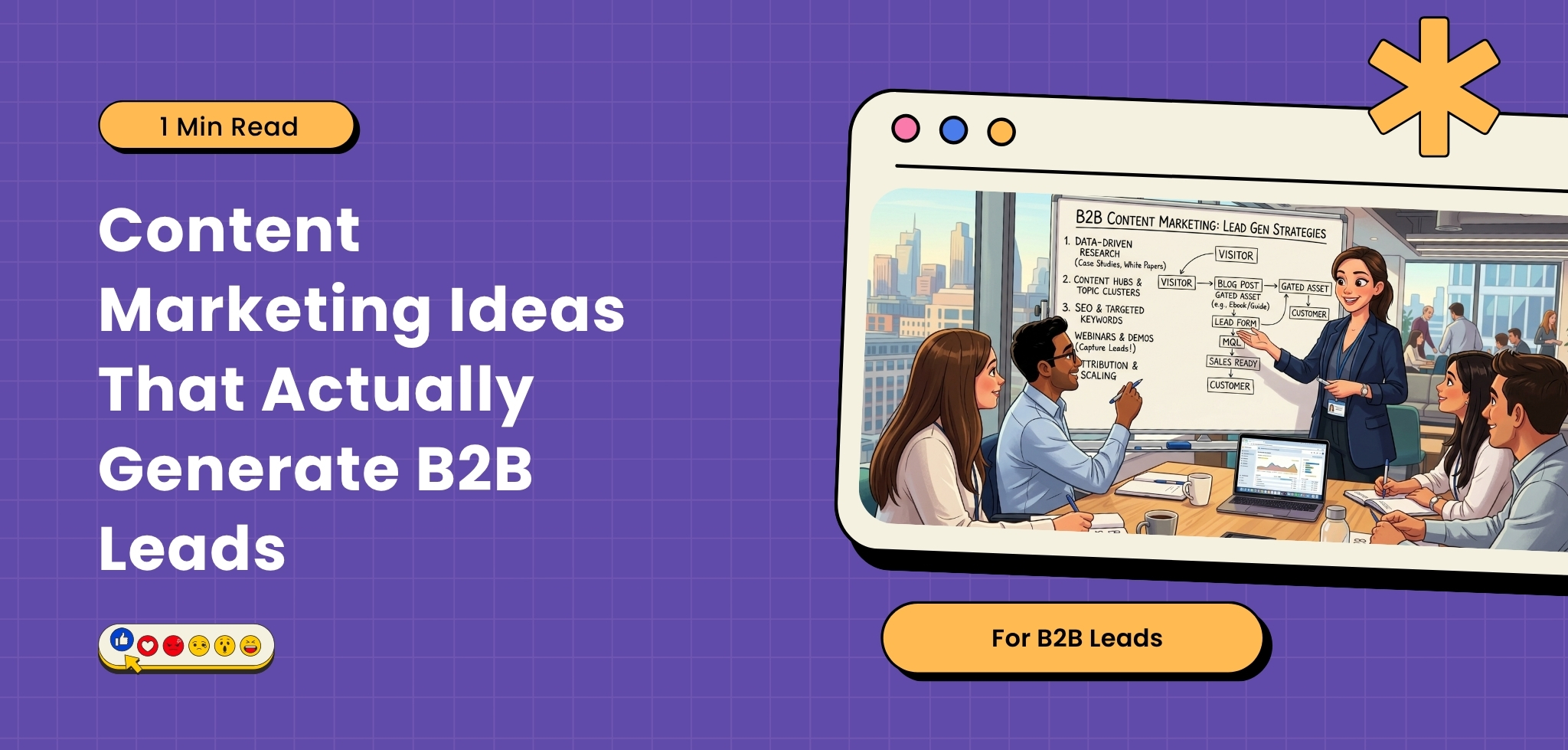
Why Is Your B2B Content Getting Views but Not Leads?
Problem Statement
Most B2B companies don’t have a content shortage. They have a content relevance problem. They publish generic blogs, industry updates and educational posts because everyone says content marketing is important. But the sales team rarely gets better enquiries from it. The reason is simple: content that attracts readers isn’t automatically content that attracts buyers. Good B2B content should answer the questions prospects ask before speaking to sales, remove uncertainty, demonstrate expertise and give the right person a reason to take the next step.
Stop Asking “What Should We Post?”
Ask This Instead.
Before creating another article, ask:
What is our sales team repeatedly explaining to prospects?
That question can uncover months of useful content.
If prospects constantly ask about pricing, specifications, implementation, timelines, compatibility, materials, ROI or vendor selection, those questions are content opportunities.
Your sales conversations are often your best content calendar.
Content Ideas That Can Actually Influence B2B Buyers
1. “How to Choose” Guides
(Similar to the one your are reading)
These work because the prospect is already evaluating options.
Examples:
- How to Choose a Packaging Manufacturer
- How to Select the Right CRM for a Manufacturing Business
- How to Choose an Industrial Water Purification System
- How to Select a Contract Manufacturer
Don’t make these generic.
Show the buyer what actually matters.
2. Comparison Content
Comparison searches are often commercially valuable.
Examples:
Product A vs Product B
In-house vs Outsourced : Example
Traditional vs Modern : Example
Service A vs Service B : Example
The objective isn’t necessarily to attack competitors.
It’s to help buyers make a more informed decision while demonstrating why your expertise matters.
3. Problem-Solution Content
Instead of writing about your company, write about the problem your buyer is experiencing.
For example:
Why Are Your B2B Leads Not Converting Into Sales?
Why Is Your Manufacturing Cost Increasing?
Why Are Your Packaging Orders Getting Delayed?
Why Are Your Industrial Enquiries Low Quality?
These topics naturally connect expertise with a commercial problem.
4. Technical Explainers
Technical B2B businesses have a major content advantage.
Your engineers and salespeople already know things your customers don’t.
Turn that knowledge into:
- Technical guides
- Specification explainers
- Application guides
- Process breakdowns
- Material comparisons
- Maintenance guides
- Troubleshooting content
You don’t need to dumb the content down.
You need to make complex information easier to understand.
5. Case Studies That Explain the Thinking
A case study shouldn’t simply say:
“Client had a problem. We provided a solution. Results were great.”
Show the thinking.
Explain:
What was wrong?
What did you change?
Why did you change it?
What happened next?
For B2B buyers, the process can be as convincing as the result.
6. Pricing and Cost Guides
B2B buyers care about budgets.
That doesn’t mean you have to publish an exact price for everything.
You can explain:
- What affects pricing
- Cost drivers
- Minimum order quantities
- Implementation costs
- Maintenance costs
- Factors that increase or decrease the final quote
This helps qualify prospects before they contact sales.
7. Industry-Specific Content
One generic page saying:
“Solutions for Every Industry”
is rarely enough.
Create dedicated content for the industries you genuinely serve.
For example:
Packaging Solutions for FMCG Companies
CRM for Manufacturing Businesses
Water Treatment Solutions for Hospitals
The closer the content is to the buyer’s context, the easier it becomes to demonstrate relevance.
8. Buyer Checklists
Checklists are excellent lead-generation assets because they are useful before a purchase.
Examples:
- Manufacturing Vendor Selection Checklist
- B2B Website SEO Checklist
- CRM Implementation Checklist
- Packaging Supplier Checklist
- Export Readiness Checklist
A strong checklist can also become a downloadable lead magnet when appropriate.
What Most B2B Content Strategies Get Wrong?
They optimise for traffic instead of buying intent
“What is digital marketing?”
may attract thousands of searches.
But:
“Digital marketing agency for B2B manufacturing companies”
is much closer to a commercial conversation.
You need both awareness and commercial content, but don’t confuse traffic volume with pipeline value.
They outsource expertise instead of capturing it
A writer sitting outside your business may produce grammatically perfect content.
But your sales team knows:
- What customers misunderstand
- Why deals get stuck
- What competitors promise
- What objections come up
- What specifications matter
- Why customers choose you
That knowledge is your content advantage.
Build Content for Google and AI Search
B2B buyers are increasingly using AI tools alongside traditional search.
That means your content should be:
- Clear
- Specific
- Well structured
- Factually useful
- Original
- Easy to understand
- Supported by real expertise
Answer important questions directly.
Explain industry terminology.
Create strong relationships between your company, products, industries and expertise.
Don’t write for an “AI algorithm.”
Write content that makes it easy for both people and search systems to understand what you actually know.
How We’d Turn Content Into a Lead Engine
We would build content across four layers:
1. Awareness
Industry problems, trends and educational topics.
2. Consideration
Comparisons, guides, technical explainers and solution pages.
3. Decision
Case studies, pricing guides, implementation information and product pages.
4. Conversion
RFQs, consultations, demos, audits and enquiry forms.
The mistake is building 90% of your content at the awareness level and wondering why nobody contacts sales.
Measure Content by Pipeline, Not Applause
Don’t stop at:
Pageviews
Impressions
Time on page
Also track:
Organic enquiries
MQLs
SQLs
Enquiry quality
Assisted conversions
Pipeline generated
Revenue influenced
A B2B article with 500 highly relevant visitors can be more valuable than one with 50,000 irrelevant visitors.
Why Growthify?
Growthify approaches B2B content from the intersection of SEO, lead generation and sales. We look at what buyers search for, what sales teams hear repeatedly, which commercial pages need support, and where content can create a path toward an enquiry. For businesses such as Miezu and TheBaxsaaco, the broader lesson is clear: generating attention is not enough. The content and acquisition system needs to attract people who have a genuine business reason to start a conversation.