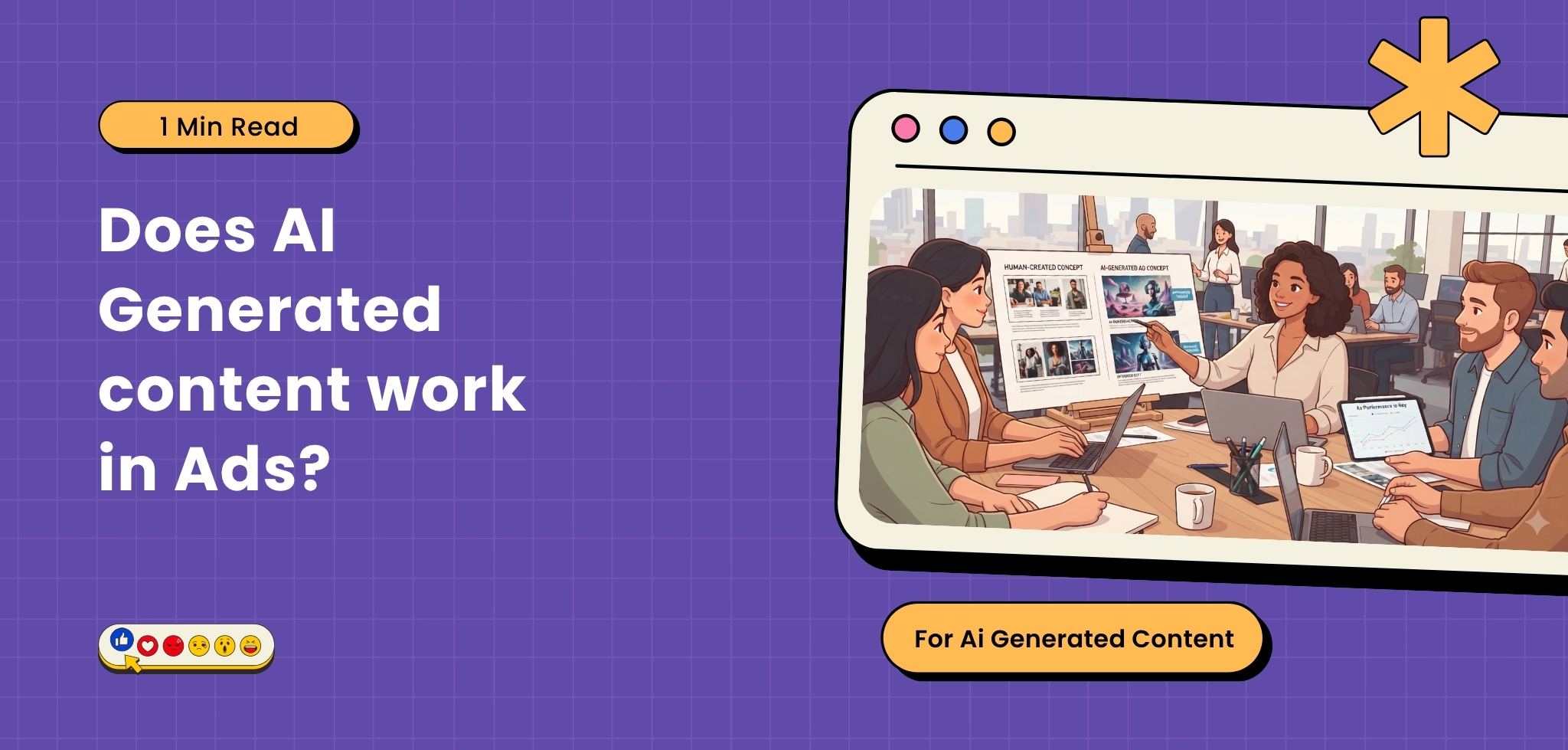
Problem Statement
Creating ad creatives consistently is a challenge for D2C brands. You need fresh product visuals, new hooks, different video formats and multiple versions of the same advertisement to test what drives sales. Traditional production can be expensive and slow, especially when campaigns require frequent creative updates. AI tools promise to make this process faster and cheaper, but there is a catch. An advertisement can look polished and still fail to generate purchases. The real question is not whether AI can create ads, but whether those ads can persuade your target customers to buy.
When Does AI Generated Content Actually Work in Ads?
AI is most useful when it helps a brand test more meaningful creative ideas, rather than simply producing more advertisements.
For example, a skincare brand could use AI to explore different campaign concepts around its product benefits, while a fashion brand could test alternative visual directions and promotional messages. The objective is to discover which combination earns attention, builds confidence and encourages a purchase.
At Growthify, we’d treat AI as a creative production and experimentation tool, not a replacement for marketing strategy.
Where AI Can Give Your Ad Creative Process an Advantage
1. Test more creative angles without restarting production
A single product can solve different customer problems. Your advertisement should reflect those differences.
For example, a home and lifestyle brand might test a product-focused creative, a problem-solution concept and a gifting angle. AI can help develop variations of headlines, scripts, storyboards and visual concepts.
What to do: Start with three distinct creative angles and create variations for each. Test them against your existing creatives.
What to avoid: Producing dozens of nearly identical ads. More variations do not automatically mean better results.
Check our case study for a pooja essential brand where we scaled ROAS from 1.5x to a consistent 4x . We majorly used AI generated statics to set up a foundational group for warming up pixel.
2. Make product visuals and demonstrations more useful
AI-generated backgrounds, lifestyle scenes and supporting visuals can help brands explore creative concepts without organising a full production shoot for every idea.
However, product accuracy matters. If AI changes a product’s shape, colour, packaging or functionality, the advertisement may mislead customers and damage trust.
What to do: Use approved product images as references, review every generated visual and ensure that the final advertisement accurately represents what customers receive.
Commercial impact: Better creative testing can help you identify product presentations that attract relevant shoppers without unnecessary production costs.
3. Adapt creatives to different audiences and platforms
The same advertisement may not work equally well on Instagram Reels, Meta feed placements and Google Display campaigns.
AI can help adapt scripts, captions, aspect ratios and creative concepts to different placements. It can also help explore messaging for first-time buyers versus returning customers.
What to do: Adapt the opening hook, format and message to the placement and audience. Keep the underlying product promise consistent.
What to avoid: Publishing the same generic AI creative everywhere without considering customer intent or platform requirements.
Why AI Ads Can Still Underperform?
AI makes production easier, but it does not automatically solve the reasons people ignore advertisements.
- Weak messaging: A visually attractive ad cannot compensate for an unclear value proposition.
- Low trust: Artificial-looking people, unrealistic product demonstrations and exaggerated claims can make customers hesitant.
- Poor creative strategy: Generating content without a clear hypothesis produces activity, not necessarily learning.
- Weak conversion experience: If the landing page has unclear pricing, limited product information or checkout friction, better creatives may not translate into sales.
Our view is that AI should improve the quality and speed of experimentation. The winning creative still needs to communicate a relevant reason to buy.
Moreover from the desk of our founder (Hardik Rupera) : We have noticed AI generated content is faster in production, but even faster in fatigue is not made with precision.
How Should D2C Brands Measure AI Ad Performance?
Do not judge AI creatives by how quickly they are produced or how many variations you publish. Evaluate them against your business objectives.
| Metric | What it tells you |
| Click-through rate (CTR) | Whether the creative attracts attention and encourages clicks |
| Cost per click (CPC) | How much you pay to attract traffic |
| Conversion rate | Whether visitors take the desired action |
| Customer acquisition cost (CAC) | How much it costs to acquire a customer |
| Return on ad spend (ROAS) | How much attributed revenue advertising generates relative to spend |
Compare AI-assisted creatives with your existing control creatives under reasonably consistent conditions. Account for audience, placement, budget, attribution and conversion volume before drawing conclusions.
For brands using Meta Ads or Google Ads, creative performance should be assessed alongside landing-page experience, product margins and repeat purchases. A higher CTR is not necessarily a better result if it attracts shoppers who do not convert.
AI can also support AEO and GEO content workflows, but creating AI-assisted ad creatives is different from optimising a website for Google AI Overviews, ChatGPT, Gemini or Perplexity. Each requires its own strategy and measurement.
Why Growthify?
At Growthify, we’d approach AI content creation as part of a broader creative testing and performance marketing process. We’d first understand the product, customer objections, brand guidelines and campaign objectives. Then we’d use AI to develop creative concepts and variations that can be tested through relevant advertising channels. We would evaluate the results against meaningful business metrics, refine underperforming concepts and scale those that demonstrate value. For D2C brands, the goal is not simply to produce more content. It is to build a repeatable process for creating, testing and improving advertisements that support profitable customer acquisition.