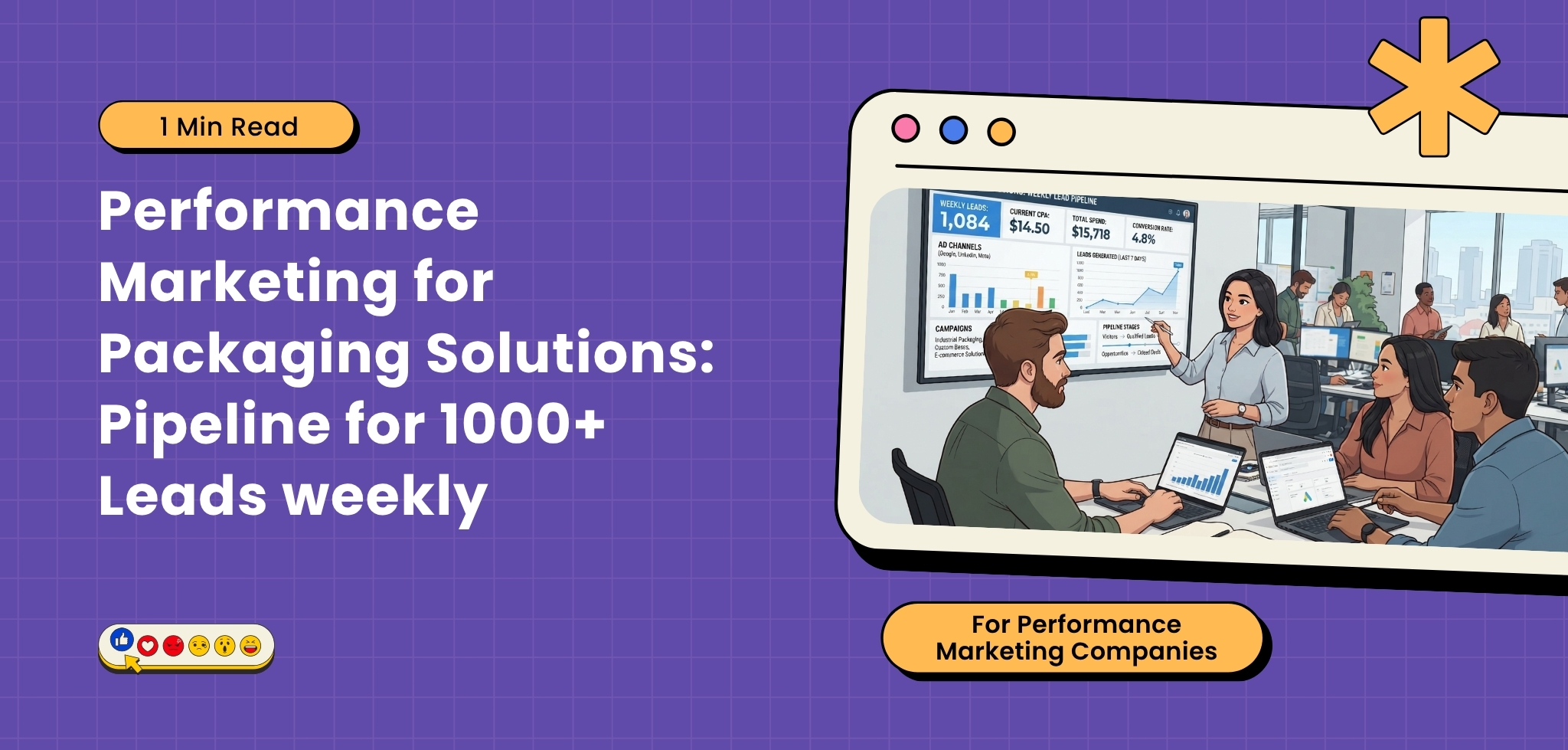
How Can Performance Marketing Help Packaging Companies Build a Stronger Sales Pipeline?
Problem Statement
Packaging companies can have the right manufacturing capabilities, competitive pricing, and a strong product range but still struggle to generate a predictable flow of business enquiries. Performance marketing for packaging solutions companies focuses on reaching businesses that need your packaging solutions and turning advertising spend into qualified sales opportunities. Some companies receive enquiries from buyers who need small quantities, others attract businesses outside their service area, and many find that paid campaigns generate clicks without producing sales opportunities. The challenge is not simply to get more leads. It is to reach the right businesses, communicate your capabilities clearly, and build a reliable process for converting enquiries into qualified opportunities.
Why More Leads Do Not Always Mean More Business
Packaging is a broad market. A company may supply corrugated boxes, flexible packaging, labels, rigid containers, food packaging, industrial packaging, or customised solutions. Each category has different buyers, purchasing requirements, order volumes, and sales cycles.
A campaign targeting everyone searching for packaging may attract students, small businesses looking for a few boxes, job seekers, competitors, and procurement teams with very different requirements.
The result can be a high lead count but limited commercial value.
Performance marketing for Packaging Solutions companies should therefore begin with a clear definition of a qualified enquiry. Depending on your business, this might include the buyer’s industry, required packaging type, estimated quantity, location, customisation needs, and expected purchase timeline.
The purpose is to generate demand that your sales team can realistically convert.
What Should You Fix Before Increasing Your Advertising Budget?
1. Define the Customers You Actually Want
Start by identifying the industries, business sizes, and buyer roles most relevant to your packaging solutions.
Potential audiences may include manufacturers, food and beverage companies, pharmaceutical businesses, ecommerce brands, retailers, distributors, and industrial suppliers. However, the right audience depends on your product range, certifications, production capacity, and commercial priorities.
Document the characteristics of a good customer. Include the packaging requirement, typical order size where known, serviceable geography, and factors that make an enquiry commercially attractive.
Use this information to prioritise campaigns and landing pages. Avoid combining unrelated products and audiences into a single campaign simply because they fall under the packaging category.
2. Match Campaigns to Specific Packaging Requirements
A buyer searching for custom corrugated packaging may have different requirements from someone looking for flexible food packaging or printed labels.
Create separate campaigns or ad groups where the differences in search intent justify them. Direct each audience to a relevant page that explains the product, available customisation, typical applications, and enquiry process.
A landing page should answer the questions buyers need resolved before contacting a supplier. These may include material options, dimensions, printing capabilities, minimum order requirements, production capabilities, and quality processes where applicable.
Do not claim capabilities, certifications, or production capacities unless your business can verify them.
3. Review Your Lead Capture Process
A campaign can attract the right visitors and still underperform if the enquiry process is confusing.
Make the next step clear. Buyers may want to request a quotation, discuss a custom requirement, ask for specifications, or speak with a packaging specialist.
Use a form that captures enough information to support qualification without making it unnecessarily difficult to enquire. Depending on the sales process, useful fields may include company name, business email, packaging type, quantity range, delivery location, and project timeline.
Test the form on mobile devices and make sure submissions reach the right sales team. Review tracking before launching campaigns so you can distinguish successful form submissions from button clicks or incomplete forms.
Which Performance Marketing Channels Should Packaging Companies Use?
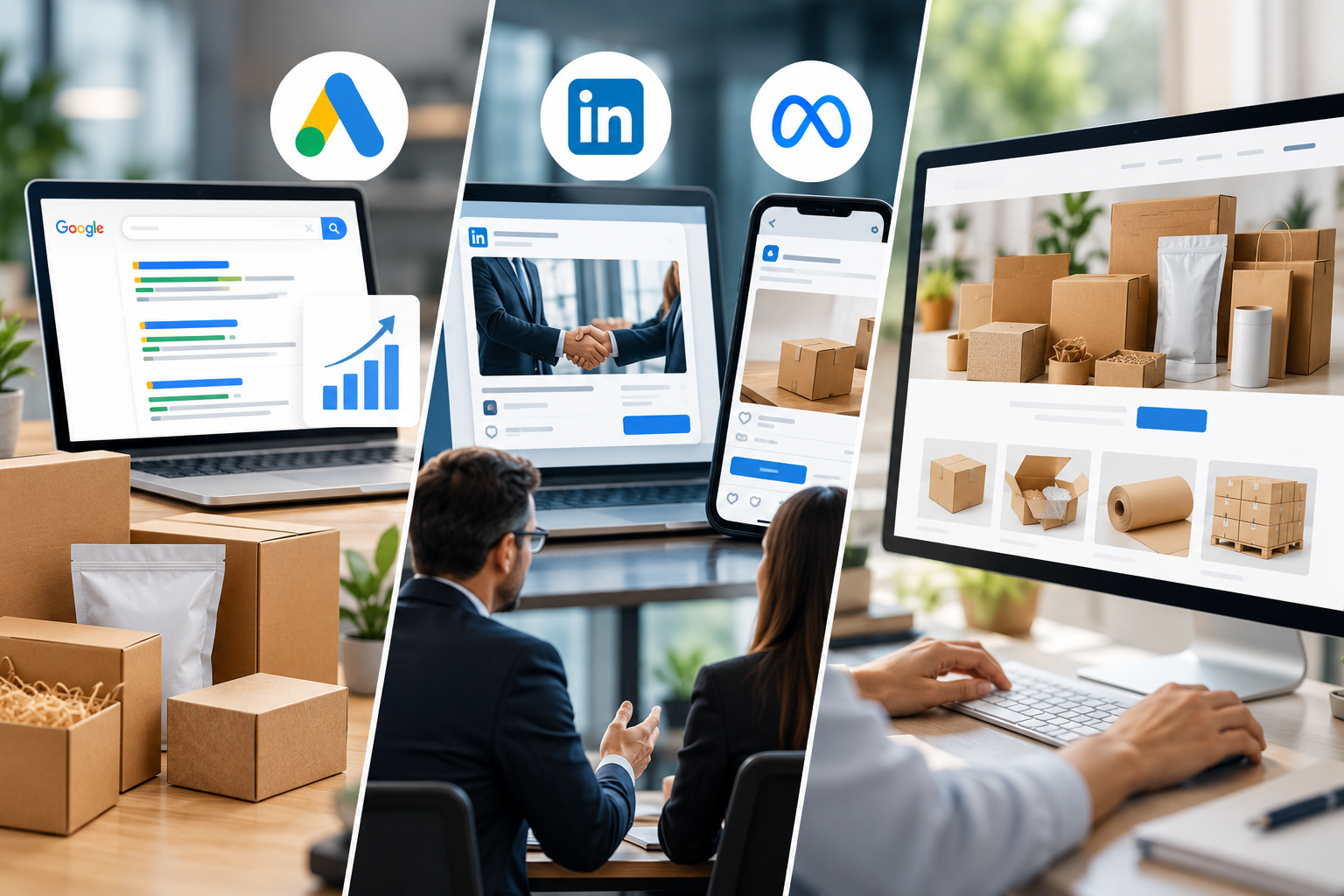
1. Use Google Ads to Capture Existing Demand
Google Search campaigns can reach buyers who are actively looking for packaging suppliers or specific packaging products.
Build keyword groups around actual commercial requirements. Depending on the company’s offering, these may include custom packaging manufacturers, bulk packaging suppliers, industrial packaging solutions, or product-specific searches.
Do not assume every keyword containing the word packaging has commercial intent. Review search terms regularly to identify irrelevant traffic and add negative keywords where appropriate.
Match each ad to a relevant landing page. An advertisement about customised industrial packaging should not send every visitor to a generic homepage.
Google Ads can be particularly useful for testing demand across product categories and regions. However, results depend on search volume, competition, offer relevance, and the quality of the landing page.
2. Use LinkedIn and Other Paid Channels Selectively
For certain B2B packaging companies, reaching decision-makers by industry or professional role may be valuable. LinkedIn advertising can support targeted awareness and lead-generation activity when the audience, offer, and budget justify the cost.
Meta Ads may also have a role in remarketing, brand awareness, and selected B2B campaigns, depending on the buyer audience and available data.
Do not choose a platform simply because it is popular. Evaluate whether it can reach the people involved in packaging decisions and whether the cost of reaching them makes commercial sense.
A useful approach is to start with a defined audience and a specific offer, then assess the quality of the resulting conversations.
3. Create Landing Pages That Help Buyers Evaluate Your Company
Packaging procurement often involves practical considerations beyond price. Buyers may need to understand material suitability, customisation, production capabilities, quality processes, delivery requirements, and the supplier’s experience with their type of project.
A strong landing page should explain these details clearly.
If you are doing performance marketing for Packaging Solutions companies, make sure your landing pages include relevant product information, real manufacturing or product imagery where available, clear enquiry options, and accurate answers to common questions. Where the business has approved case studies or customer examples, use them to demonstrate documented experience.
Avoid generic claims such as best quality or industry-leading service without evidence. Specific information helps buyers determine whether your company is suitable for their requirements.
How Can You Build a Pipeline Instead of Just Collecting Leads?
1. Connect Advertising With Lead Qualification
A form submission is not the same as a sales opportunity.
Create a qualification process that helps the team categorise incoming enquiries. Possible categories include relevant and ready to discuss, relevant but not ready, outside the service scope, and spam or invalid.
The exact criteria should reflect the business. A packaging manufacturer may prioritise order volume, production feasibility, target industry, or project timing.
Feed lead quality information back into marketing reviews. If one campaign produces many low-value enquiries while another produces fewer but more commercially relevant opportunities, the second may deserve greater attention.
This is a core principle of performance marketing for Packaging Solutions companies: optimise toward business value rather than lead count alone.
Check this if your Google ads is not generating leads.
2. Use CRM and Follow-Up Processes to Reduce Lost Opportunities
Marketing performance does not end when a lead submits a form.
Make sure enquiries are assigned to the appropriate person and followed up within a reasonable period. Record contact attempts, qualification status, quotations, next steps, and eventual outcomes in a CRM or another consistent system.
This helps identify where opportunities are being lost. The issue may be lead quality, slow follow-up, unsuitable pricing, limited capacity, or a mismatch between the offer and buyer expectations. Understanding these gaps also helps clarify what to expect from a CRM implementation partner, particularly when choosing a solution that supports your sales process and helps your team manage leads more effectively.
Use these findings to improve both marketing and sales processes. Increasing advertising spend will not solve a follow-up problem.
3. Set Realistic Lead and Budget Targets
The guide topic refers to building a pipeline of 1,000 or more leads weekly. That may be a useful ambition for some businesses, but it should not be presented as an outcome that every packaging company can achieve.
Before setting a target, estimate the available audience, expected cost per lead, lead-to-qualified rate, sales capacity, and budget required.
For example, if a business needs 1,000 leads per week, it must also establish how many of those leads need to be qualified and whether the sales team can respond to that volume. A high lead count is not useful if most enquiries are irrelevant or remain unanswered.
Set targets based on available market demand and historical performance, then refine them using actual campaign data.
Which Metrics Should Packaging Companies Monitor?
Track the complete journey from advertising to sales.
Cost per lead: How much advertising spend is required to generate an enquiry?
Qualified lead rate: What proportion of enquiries meet the company’s qualification criteria?
Cost per qualified lead: How much does it cost to generate a commercially relevant enquiry?
Quotation rate: How many qualified leads progress to a quotation or proposal?
Opportunity rate: How many enquiries become genuine sales opportunities?
Customer acquisition cost: What does it cost to acquire a customer when marketing and sales costs can be measured reliably?
Pipeline value and revenue: What commercial value is associated with marketing-generated opportunities and completed sales?
Response time: How quickly does the team act on new enquiries?
Review these metrics by campaign, product category, location, and audience where the data supports it. Avoid evaluating performance using platform-reported conversions alone when CRM data can provide a more complete view.
Why Growthify?
Growthify approaches performance marketing by connecting campaign strategy, audience targeting, landing pages, lead qualification, and business measurement. For a packaging company, we’d first understand the products, target industries, serviceable locations, commercial priorities, and sales process. From there, we’d identify the most relevant acquisition channels and establish how enquiry quality will be evaluated. We would also consider what happens after the form submission, including follow-up, qualification, and pipeline reporting. This helps the business assess whether marketing is generating useful sales opportunities, rather than simply increasing the number of enquiries.