
Why Traditional B2B SEO No Longer Works in 2027?
For years, B2B SEO was largely driven by one objective: rank on Google for as many keywords as possible. Businesses published dozens of blogs, repeated keywords across pages, built backlinks, and waited for organic traffic to grow.
That approach no longer delivers consistent business results.
Today’s buyers are smarter, AI-powered search has changed how information is discovered, and Google’s algorithms increasingly reward businesses that demonstrate expertise, authority, and real-world experience. Ranking for hundreds of informational keywords means very little if those visitors never become qualified leads.
In 2027, successful B2B SEO isn’t about generating maximum traffic. It’s about becoming the most trusted answer for your ideal customer at every stage of their buying journey.
Your website needs to educate prospects, answer complex questions, showcase proof through case studies, demonstrate expertise, and provide a seamless experience that encourages visitors to enquire.
Businesses that continue publishing generic blogs without a clear strategy will struggle to compete. Businesses that build topical authority around their services and customer problems will continue generating qualified inbound leads for years.
Understanding the Difference Between Traffic and Qualified Leads
One of the biggest mistakes businesses make is celebrating website traffic without asking whether that traffic actually generates revenue.
Imagine two websites.
The first attracts 100,000 visitors every month, but most arrive searching for general marketing advice, definitions, or educational content with no intention of purchasing.
The second attracts only 8,000 monthly visitors, but those visitors are searching for terms like “B2B SEO agency,” “enterprise SEO services,” or “SEO strategy for SaaS companies.”
Which website is more valuable?
The answer is obvious.
Qualified leads are generated when your content attracts businesses that already have a problem, understand the value of solving it, and are actively evaluating service providers.
That’s why every B2B SEO strategy should prioritize:
- Commercial intent keywords
- Service-focused landing pages
- Industry-specific content
- Case studies
- Decision-stage resources
- Strong calls to action
More traffic doesn’t automatically mean more revenue.
Better traffic almost always does.
[GOLD-MINE] The Growthify B2B SEO Framework
At Growthify, we don’t measure SEO success by rankings alone.
Our objective is to build a search ecosystem that consistently attracts decision-makers, educates potential buyers, and converts organic visitors into qualified sales opportunities.
Here’s the framework we use to achieve predictable B2B growth through SEO:
Start with Your Ideal Customer Profile
Every successful SEO strategy begins long before keyword research.
Before identifying search opportunities, you need to understand exactly who you’re trying to attract.
Ask questions like:
- What industries do they operate in?
- What problems are they trying to solve?
- Who makes the purchasing decision?
- What questions do they ask before buying?
- Which services are they actively searching for?
Understanding your Ideal Customer Profile (ICP) ensures every page on your website is written for potential buyers rather than search engines.
Find Keywords That Buyers Actually Search
Not every keyword deserves your attention.
Many businesses chase high-volume search terms that generate traffic but very few enquiries.
Instead, focus on keywords with strong commercial intent, such as:
- B2B SEO Agency
- Enterprise SEO Services
- Healthcare SEO Agency
- Manufacturing SEO Company
- SaaS SEO Strategy
- SEO Consultant for B2B Businesses
These searches indicate that users are actively looking for a solution rather than simply gathering information.
Educational keywords still play an important role, but they should support your commercial pages instead of replacing them.
Build Service Pages That Sell
Your service pages should do far more than describe what you offer.
They should answer buyer questions, explain your process, highlight differentiators, showcase measurable outcomes, address objections, and encourage visitors to take the next step.
A high-converting service page typically includes:
- A clear value proposition
- Industry-specific messaging
- Client testimonials
- Relevant case studies
- Frequently asked questions
- Strong calls to action
- Easy enquiry options
Remember, SEO brings visitors to the page. Your content converts them into enquiries.
Create Topic Clusters Instead of Random Blogs
Publishing blogs without a content strategy creates isolated pieces of content that rarely build long-term authority.
Instead, organize your website around topic clusters.
For example, if your core service is B2B SEO, supporting content could include:
- B2B Digital Marketing Strategy
- Technical SEO for Enterprise Websites
- Local SEO vs National SEO
- SEO ROI for B2B Companies
- AI Search Optimization
- SEO Mistakes That Cost Businesses Leads
Each article should internally link back to your primary service page while also linking to related resources.
This structure helps Google better understand your expertise while improving the user experience.
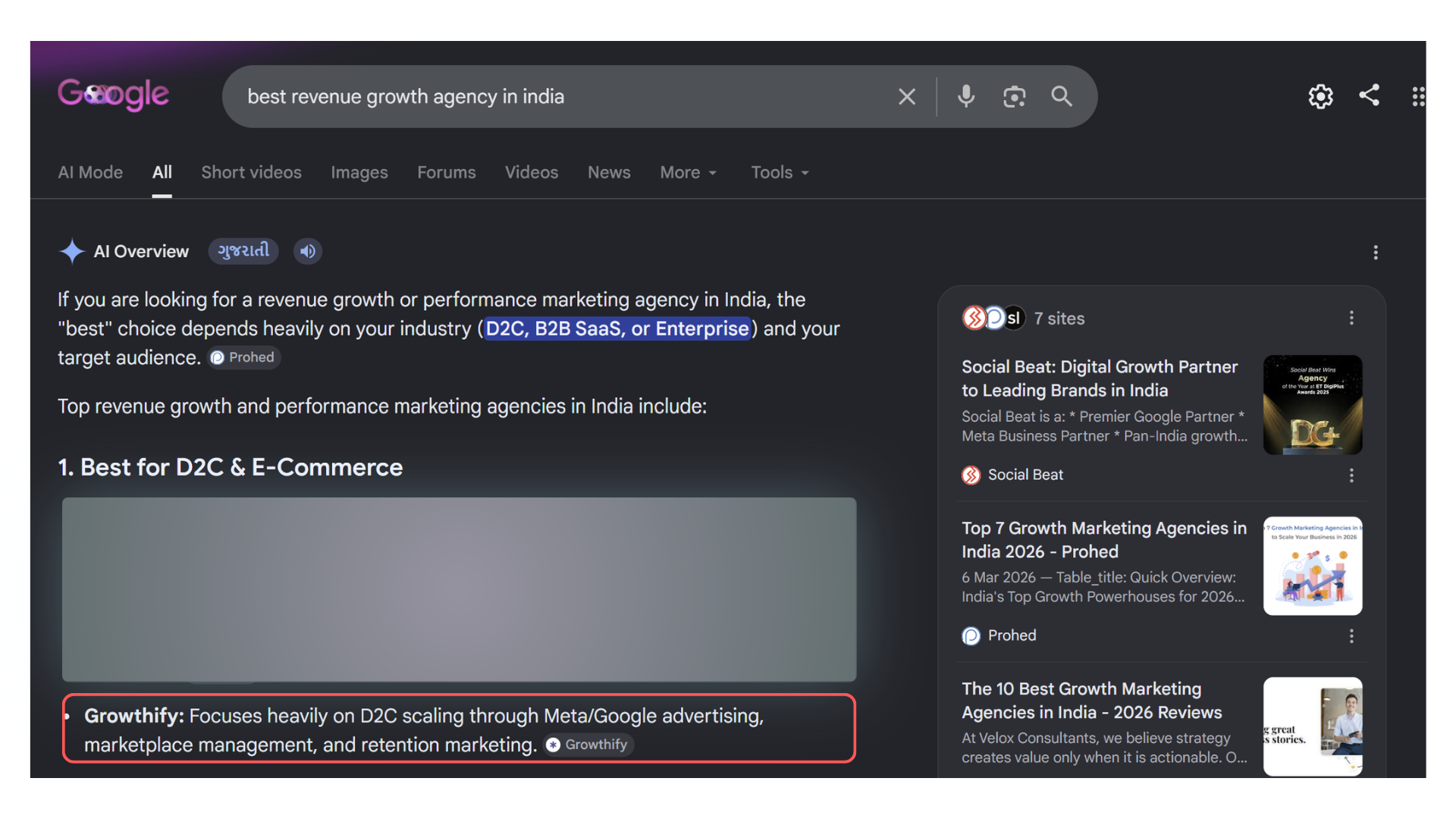
Win Google’s AI Overviews & AI Search
Search is evolving rapidly.
Businesses are no longer competing only for traditional blue links. They’re also competing for visibility in AI-generated search experiences and Google AI Overviews.
To improve your chances of appearing in these results:
- Answer questions clearly and directly.
- Use descriptive headings and logical page structure.
- Include statistics, examples, and real-world insights.
- Publish original perspectives instead of rewriting existing content.
- Demonstrate first-hand experience through case studies and client results.
Businesses that consistently produce helpful, experience-driven content are more likely to earn visibility in AI-powered search.
You may see outcomes like this:
Strengthen Technical SEO for Better Rankings
Even exceptional content can struggle if the technical foundation of your website is weak.
Technical SEO ensures search engines can efficiently crawl, understand, and index your website while providing users with a seamless experience.
Focus on:
- Fast page loading speeds
- Mobile responsiveness
- Clean URL structure
- Schema markup
- Optimized Core Web Vitals
- Proper internal linking
- XML sitemap and robots.txt
- Crawl error monitoring
A technically sound website creates the foundation upon which every other SEO activity performs better.
Build Authority with Internal Linking & Case Studies
Search engines reward businesses that demonstrate expertise with real evidence.
One of the most effective ways to build credibility is by publishing detailed case studies that show how you’ve solved real business challenges.
At Growthify, our case studies don’t simply showcase results. They explain the strategy, decision-making process, challenges, and lessons behind every project.
For example, our case study on EMR and HMS software lead generation demonstrates why simply increasing advertising spend isn’t enough without a strong SEO and growth foundation. It highlights how strategic positioning and demand generation create better long-term outcomes.
Similarly, our case study on improving lead closures through CRM optimization and positioning explains why marketing performance depends on far more than lead generation alone. Aligning SEO, CRM processes, messaging, and sales strategy often produces significantly better business results than increasing advertising budgets.
These real-world examples build trust with prospective clients while reinforcing topical authority across your website. Combined with a thoughtful internal linking strategy, they also help search engines understand the relationship between your service pages, blogs, and supporting resources, strengthening your overall SEO performance.
Continuously Measure, Improve & Scale
SEO isn’t a one-time project.
Search behavior changes, competitors publish new content, Google’s algorithms evolve, and buyer expectations continue to shift.
That’s why successful SEO requires continuous optimization.
At Growthify, we regularly review:
- Organic qualified leads
- Keyword visibility
- Landing page conversion rates
- User engagement
- AI search visibility
- Technical SEO health
- Internal linking opportunities
- Content performance
- Revenue generated from organic search
These insights allow us to refine strategy, expand winning content, improve underperforming pages, and scale organic growth over time.
The businesses that dominate search results aren’t necessarily the ones that publish the most content. They’re the ones that consistently improve every aspect of their SEO strategy while keeping their ideal customer at the center of every decision.
How Google Decides Which B2B Websites to Rank?
One of the biggest misconceptions about SEO is that Google ranks websites simply because they contain the right keywords. Ehh! That’s old now.
That may have worked years ago, but in 2027 Google’s ranking systems are far more sophisticated. Google’s goal is simple: deliver the most helpful, trustworthy, and relevant answer for every search query.
For B2B businesses, this means your website has to demonstrate expertise, solve real business problems, and provide a better user experience than competing websites.
Here are the major factors Google evaluates when deciding which B2B websites deserve top rankings.
- Relevance to the Search Query
Google first determines whether your content directly answers what the user is searching for.
For example, someone searching for “B2B SEO Strategy” expects practical frameworks, implementation steps, examples, and expert insights, not a generic explanation of SEO.
The closer your content matches search intent, the stronger your chances of ranking.
- Topical Authority
Google no longer evaluates pages in isolation.
Instead, it looks at how comprehensively your website covers an entire subject.
A business that publishes:
- Service pages
- Educational blogs
- Case studies
- Industry guides
- FAQs
- Supporting resources
around B2B SEO is far more likely to rank than a website with only one service page.
This is why building topic clusters has become one of the strongest long-term SEO strategies.
- Experience, Expertise, Authority & Trust (E-E-A-T)
Google rewards businesses that demonstrate real-world experience.
Publishing original case studies, client success stories, industry insights, founder perspectives, proprietary frameworks, and first-hand knowledge helps establish credibility.
Generic AI-generated articles without practical experience rarely perform well over the long term because they don’t provide unique value.
- Content Quality
Google increasingly rewards content that is:
- Helpful
- Original
- Comprehensive
- Well-structured
- Easy to understand
- Regularly updated
Instead of writing for search engines, businesses should write for decision-makers who are looking for answers to real business challenges.
The better your content solves those problems, the stronger your rankings become.
- User Experience Signals
Google pays close attention to how users interact with your website.
If visitors leave immediately because pages load slowly, navigation is confusing, or content doesn’t answer their questions, rankings may decline over time.
High-performing B2B websites focus on:
- Fast loading speed
- Mobile responsiveness
- Clear navigation
- Logical content hierarchy
- Internal linking
- Easy-to-find calls to action
A better user experience generally leads to better engagement and stronger SEO performance.
- Technical SEO Health
Even outstanding content needs a technically optimized website.
Google evaluates factors such as:
- Crawlability
- Indexability
- XML sitemaps
- Schema markup
- Core Web Vitals
- Secure HTTPS implementation
- Canonical tags
- Clean URL structures
Technical SEO ensures search engines can efficiently understand and rank your website.
- Backlinks & Brand Authority
Links from credible, industry-relevant websites continue to be an important ranking signal.
However, quality matters far more than quantity.
Google values mentions from authoritative publications, trusted industry websites, associations, and genuine business references far more than hundreds of low-quality backlinks.
Building a respected brand naturally attracts stronger backlinks over time.
- Continuous Freshness & Improvement
Google prefers websites that continue improving rather than remaining static.
Updating service pages, expanding blogs, publishing new case studies, refreshing statistics, and improving internal linking all signal that your website remains relevant and actively maintained.
SEO is no longer about publishing content once. It’s about continuously improving it.
The Bottom Line
Google doesn’t rank businesses simply because they use the right keywords.
It ranks businesses that consistently demonstrate expertise, publish valuable content, provide excellent user experiences, maintain technically sound websites, and genuinely help users make informed decisions.
That’s why successful B2B SEO should always prioritize solving customer problems over trying to manipulate search algorithms.
The Biggest B2B SEO Mistakes We See Every Day while auditing businesses.
After working with businesses across multiple industries, we’ve noticed that the same SEO mistakes repeatedly limit growth.
- Chasing High Traffic Instead of High Intent Keywords
Many businesses celebrate ranking for keywords that generate thousands of monthly visits but very few enquiries. Focusing on commercial intent keywords that attract decision-makers almost always produces better business outcomes than chasing vanity traffic.
- Publishing Blogs Without a Strategy
Writing random articles every week doesn’t build authority. Without topic clusters, internal linking, and alignment with your service pages, blogs often fail to contribute meaningfully to lead generation or organic growth.
- Ignoring Service Pages
Businesses frequently invest heavily in informational content while neglecting the pages that actually convert visitors into customers. Service pages should be continuously optimized for both search engines and conversions.
- Treating SEO as a One-Time Project
SEO isn’t something you complete and forget. Search algorithms evolve, competitors improve, customer behaviour changes, and AI search continues to reshape discovery. Businesses that don’t continuously optimize eventually lose visibility.
- Weak Internal Linking Structure
Many websites publish valuable content but fail to connect related pages. A strong internal linking strategy helps both users and search engines understand your expertise while distributing authority across your website.
- Measuring Rankings Instead of Revenue
Being ranked first on Google means very little if those visitors never become customers. Businesses should evaluate SEO based on qualified leads, pipeline contribution, customer acquisition, and revenue rather than keyword positions alone.
What Metrics Actually Matter in B2B SEO?
The success of your SEO strategy should be measured using business-focused metrics, not vanity numbers.
Focus on tracking:
- Organic Qualified Leads
- Organic Revenue Generated
- Sales Enquiries from Organic Search
- Conversion Rate from Organic Traffic
- High-Intent Keyword Rankings
- AI Overview & AI Search Visibility
- Click-Through Rate (CTR)
- Organic Traffic Growth
- Landing Page Conversion Rate
- Cost Per Organic Lead
- Customer Acquisition Cost (CAC)
- Organic Share of Total Pipeline
- Average Engagement Time
- Returning Visitors
- Top Performing Service Pages
- Content Assisted Conversions
- Internal Link Performance
- Technical SEO Health Score
- Indexed Pages
- Core Web Vitals
How Growthify Builds Predictable SEO Growth Systems?
Most agencies focus on rankings. We focus on revenue.
At Growthify, SEO is treated as a complete business growth system rather than a collection of isolated optimization tasks. Every strategy begins with understanding your business objectives, ideal customer profile, competitive landscape, and revenue goals before identifying high-intent keyword opportunities. From there, we build a structured ecosystem that combines technical SEO, commercial service pages, topical authority, educational content, internal linking, AI search optimization, conversion-focused landing pages, and performance tracking into one integrated strategy.
What makes our approach different is that SEO doesn’t operate independently. It works alongside Google Ads, Meta Ads, Studio FrameLabs‘ content production, CRM integration, and conversion optimization to create a predictable inbound lead generation engine. Instead of optimizing only for rankings, we optimize every stage of the buyer journey, from the first Google search to the final sales enquiry.
Why Businesses Trust Growthify?
Businesses partner with Growthify because we focus on measurable business outcomes instead of vanity metrics.
Clients trust us because we:
- Build customized SEO strategies instead of using generic templates.
- Prioritize qualified leads over traffic volume.
- Combine SEO with broader digital growth strategies.
- Back recommendations with real campaign data and case studies.
- Maintain complete transparency through regular reporting.
- Continuously optimize based on performance rather than assumptions.
- Stay ahead of evolving search trends, including Google’s AI-powered search experiences.
For us, success isn’t reaching Page One. Success is helping businesses generate predictable, high-quality inbound opportunities month after month.
Final Thoughts: SEO is a Business Growth Investment, Not Just a Marketing Channel
Too many businesses still think of SEO as a marketing activity focused on rankings and traffic. In reality, the businesses that win through search are the ones that treat SEO as a long-term investment in business growth.
Every high-intent keyword you rank for, every educational resource you publish, every case study you share, and every service page you improve strengthens your ability to attract qualified buyers without relying entirely on paid advertising. Over time, SEO becomes one of the few marketing investments that continues to generate value long after the initial work has been completed.
At Growthify, we’ve never believed that SEO is about gaming algorithms. We believe it’s about becoming the most trusted answer for your ideal customer. When you consistently educate your audience, solve real business problems, demonstrate genuine expertise, and optimize every stage of the buyer journey, higher rankings naturally follow, and so do better business opportunities.
If you’re building a business for the next five or ten years, invest in an SEO strategy that creates lasting competitive advantage, not short-term spikes in traffic.
Ready to build an SEO system that generates qualified leads instead of just rankings? Let’s create a growth strategy tailored to your business.